Selling Wholesale Across EU Borders: One Platform, Many Markets

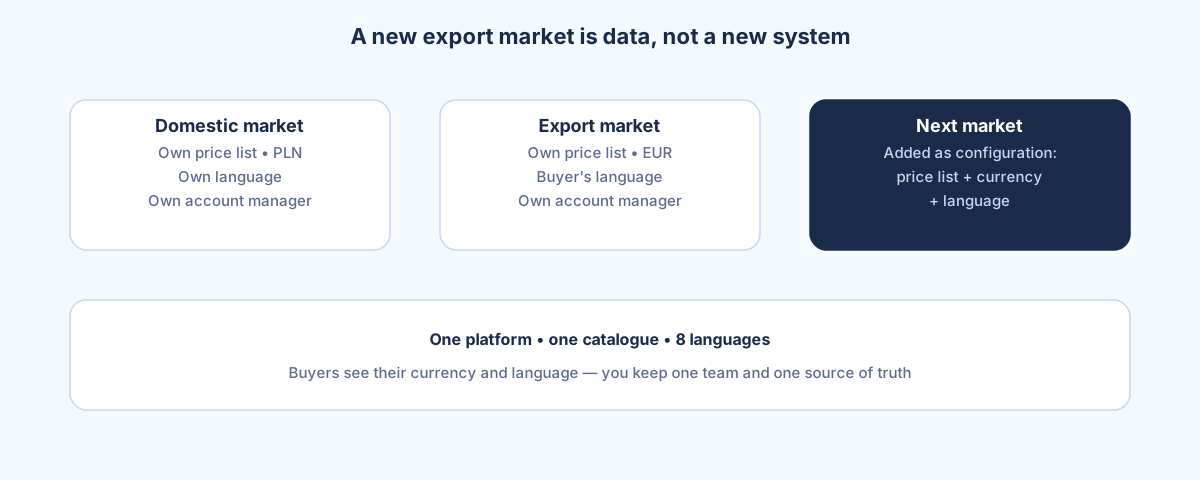
Selling wholesale across EU borders works best when each market is a set of data, not a separate system. In Selldi a market is a customer group with its own price list, its own currency and its own language, so an exporter can price the domestic shelf in the local currency and the export shelf in euros while both draw on the same catalogue, stock and customer records. The storefront and the B2B portal run in eight languages, product visibility can differ per market, and documents and emails reach the buyer in their own language. Selldi is an all-in-one sales system for wholesalers and distributors, so adding a country means adding a market and attaching an account manager, not standing up a second store. That is the difference between growing into export and duplicating your whole operation to do it.
What actually breaks when a wholesaler starts exporting
The first export order rarely reveals the problem. The trouble shows up around the tenth, when the workarounds have hardened into habits. Currency is usually the first thing to crack: someone converts euros to the domestic currency by hand, or a rep quotes a euro figure from an exchange rate they remember, and by the time the order is booked the margin is not quite what anyone intended. Nobody is careless; the process just has no single place where the export price lives, so it lives in people's heads and in the last email they sent.
The second thing to break is the catalogue itself. A common reaction to 'we need a German-language shop' is to spin up a second webshop and copy the products across. It works for a week. Then a price changes on the home store and not on the export one, a product goes out of stock in one system and stays live in the other, and now two catalogues describe the same warehouse and disagree about it. Every edit has to be done twice, which means sooner or later it gets done once. The export site drifts into being a slightly wrong copy of the real one.
The third is subtler and it is about people. Reps quoting across borders end up carrying stale numbers, an old FX rate, a discount that expired, a price list from before the last increase, because the information they need is scattered. The customer experiences this as inconsistency, and inconsistency in wholesale reads as unreliability. None of these failures are dramatic on their own. Together they are the reason a lot of promising export lines stall.
The market-as-data model
The alternative is to treat a market as configuration rather than code. In Selldi, adding a market means creating a customer group, giving it a currency and a language, attaching an account manager and setting its price list. That is the whole operation. There is no second database, no duplicated catalogue and no developer involved. The products, the stock levels and the customer accounts remain shared; what varies per market is the pricing, the currency, the language and which products are even visible.
This matters because it changes the cost of expansion from 'build another shop' to 'add a row of settings'. When markets are data, a second export region in a different currency is a half-hour of setup, not a project. Prices for that market are maintained in one place and shown only to customers who belong to it, so the domestic euro exercise and the export euro exercise never collide. And because the catalogue is single, a stock change or a new product appears everywhere at once, which quietly removes the whole class of 'the two shops disagree' problems.
- Each market has its own price list and currency, maintained independently, so export prices are set deliberately rather than converted on the fly.
- The catalogue, stock and customer data are shared across markets, so there is nothing to copy twice and nothing to keep in sync by hand.
Language: buyers buy in their own language, support stays central
A buyer in another country is far more comfortable, and far more likely to self-serve, when the portal, the catalogue and the order confirmation are in their own language. The storefront and the B2B portal run in eight languages, and the documents and emails a customer receives follow the language of their market. That removes a real friction: a purchasing manager should not have to translate an order confirmation to check it is correct.
The important part is that this does not fragment your own operation. The buyer sees their language; your team still works in one system, with one view of every market. Support and account management stay centralised even though the customer-facing surface is localised. You are not hiring a separate team per country to run a separate shop; you are serving several markets from one back office that happens to speak several languages.
Logistics, incoterms and VAT, kept in their lane
Cross-border trade brings questions a sales platform touches but does not decide. Delivery terms and incoterms determine who bears the cost and risk at each leg of the journey, and they belong in your commercial agreement with the buyer; the platform records the order and the agreed terms rather than choosing them for you. It is worth agreeing these explicitly per market, because assumptions that are obvious domestically stop being obvious once a border is involved.
VAT is the area where it pays to be careful and to defer. Intra-EU B2B sales, the One Stop Shop scheme and the treatment of goods moving between member states all have rules that depend on your specific setup, your registrations and where your customers are established. A sales platform can hold the data and reflect the prices, but the tax treatment is a question for your accountant, who confirms the details for your business. Treat anything you read here, or anywhere else online, as general orientation and let a professional sign off the specifics before you rely on them.
When a separate local system makes more sense
The market-as-data model fits a wholesaler who wants to serve several countries from one operation. It is not automatically the right answer for everyone. If a country becomes large enough to warrant its own legal entity, its own warehouse, its own local team and its own accounting, then a separate local subsidiary with its own system can be the cleaner structure, because the separation you are managing is real and organisational, not just a matter of currency and language. At that scale, forcing everything through one platform can create more coordination than it saves.
The honest test is whether your markets are variations of one business or genuinely different businesses. A domestic line and two or three export regions run by the same team, from the same stock, are variations, and they thrive on shared data with per-market pricing. A fully staffed foreign operation with its own P and L is a different business, and it may deserve its own system. Most exporting wholesalers are in the first category for years before they reach the second, which is exactly the stretch where a single multi-market platform like Selldi does the most work.
Frequently asked questions
How many markets and currencies can one wholesaler run?
Markets are data rather than code, so you can add as many as your business needs, each with its own currency, language and price list. A typical exporter runs a domestic market plus a handful of export regions from a single catalogue. Adding another one is a configuration step, not a development project.
Can one customer belong to two markets at once?
In the standard model a customer account belongs to one market, which cleanly determines their currency, language and price list. If a single buyer genuinely needs to purchase under two different sets of terms, the usual approach is a separate account per market. This keeps pricing unambiguous and prevents one buyer from seeing conflicting prices.
Do exports need a separate catalogue or a second shop?
No. That is the specific problem the market-as-data model avoids. The catalogue, stock and customer data are shared, and only pricing, currency, language and per-market product visibility differ. There is nothing to copy across and nothing to keep in sync by hand, so the export view can never drift into a wrong copy of the domestic one.
How are export prices in euros kept current?
You set the euro price you actually want to charge on the export market's price list, and it holds until you change it, rather than being converted from a fluctuating daily rate. This removes the drift caused by reps quoting from a remembered exchange rate. Prices can also be reconciled with your finance system through the ERP integration.
Does going cross-border mean handling VAT differently?
Intra-EU B2B sales and schemes like the One Stop Shop have rules that depend on your registrations and where your customers are established, and the platform records orders and prices rather than deciding tax treatment. Treat online guidance as general orientation only. Your accountant confirms the details that apply to your specific business before you rely on them.