RFQ and Quoting Online: From "What Would This Cost Me?" to a Reorderable Document

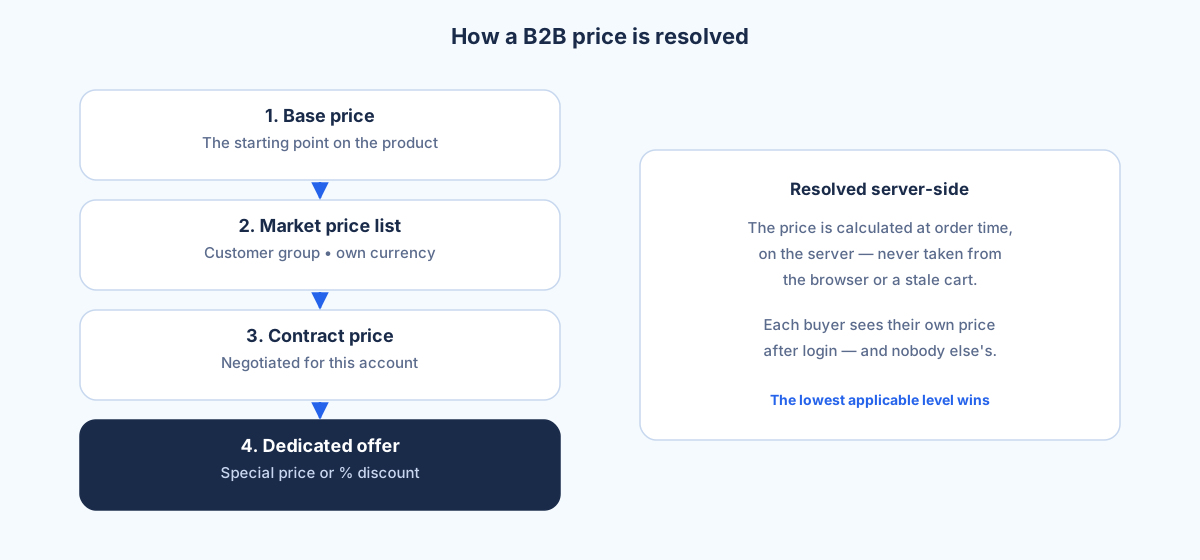
Online RFQ (request for quotation) in wholesale means a buyer or a sales rep raises a price question inside the portal, the rep answers it, and that answer becomes a live, orderable price rather than a number buried in an email thread. In Selldi, an all-in-one sales system for wholesalers and distributors, a quote turns directly into a dedicated offer, either a fixed special price or a percentage discount, that appears in the buyer's portal the moment it is issued. The rep always sees the customer's current price and where it comes from (an existing offer, a contract price, or the market list) before quoting, so every discount is measured against reality instead of guesswork. Offers can be attached to one account or to a whole market or group, and quoting a fresh request supersedes older quote-born offers for that same product and customer, which stops stale prices from quietly undercutting new ones. The result is that the question a buyer starts with, "what would this actually cost me?", ends as a document they can reorder from, not a screenshot they have to hunt for.
Wholesale starts with questions, not carts
Anyone who has spent a week on a wholesale sales desk knows the retail metaphor of "add to cart, check out" barely applies. A buyer at a construction merchant does not browse and impulse-buy a pallet of fasteners. They ask: what is my price on this at 300 units, can you do better if I take a full truck, and does that hold until the end of the quarter. B2B pricing is relationship pricing. The same product carries a shelf price for the market, a negotiated contract price for a loyal account, and a one-off special because a rep is fighting to win a project. The first move in almost every real transaction is not a purchase, it is a question.
That is why a portal that only knows how to show a fixed catalogue price misses the point of how distributors actually sell. If the buyer cannot ask "what is this for me, at this volume, right now", they pick up the phone, and the whole digital channel becomes a brochure. A serious B2B system has to treat the price request as a first-class object: something a buyer can raise, a rep can answer, and both sides can see the state of. Selldi does exactly that. A buyer looking at a product can request a price; a rep can also raise the request on the customer's behalf after a call, so the conversation that happened by phone still lands as a record inside the system.
Why the spreadsheet-and-email quote keeps failing
Most wholesalers still quote from a spreadsheet pasted into an email, and it breaks in three predictable ways. The first is stale versions. A rep sends "quote_v3_final" on Monday, revises the tonnage on Wednesday, and by Friday nobody, including the rep, is certain which PDF is the live one. The buyer places an order against the wrong version, the warehouse ships against a third, and the argument that follows costs more than the margin on the deal.
The second failure is the quote that never reaches the system. It lives in the rep's sent folder and the buyer's inbox, and nowhere else. When that rep is on holiday or leaves, the pricing they promised evaporates; the buyer reorders, gets charged shelf price, and feels cheated for a discount they were genuinely owed. The third is discount anarchy. With no shared record of what was quoted to whom, two reps can hand the same account two different prices, and a customer who pushes hard ends up paying less than a bigger, quieter one. None of these are people problems. They are the natural consequence of pricing that has no home.
What a good flow actually looks like
The clean version is a single loop that never leaves the platform: request, quote, live offer, order. A buyer (or the rep, on their behalf) raises a price request on a specific product. The rep opens it and, crucially, sees the customer's current price with its source spelled out, whether that number comes from an existing dedicated offer, a standing contract price, or the market shelf list. That context is the whole game. A discount only means something if you know what you are discounting from, and a rep quoting blind will either give away margin they did not need to or promise a "deal" that is actually worse than the customer's standing price.
The rep answers with either a fixed special price or a percentage off, and that answer immediately becomes an active dedicated offer visible in the buyer's portal. There is no separate step to "publish" the price, no PDF to attach, no window where the buyer knows a number the system does not. When the buyer is ready, they order against that offer, and because the offer is a real object the system holds the used quantities and validity against it rather than trusting a line in an email. The buyer can come back next quarter and reorder from the same document. The question became a price; the price became a repeatable transaction.
One detail that quietly matters: when a rep quotes a fresh request, Selldi supersedes older quote-born offers for that product and customer. This closes the classic trap where a buyer asked about the same item twice, two offers ended up active, and the lowest one silently won, so the rep raised the price to twelve and the customer kept paying nine for a month. Offers a rep created deliberately by hand are left alone; only the ones spawned from earlier quotes on the same line get retired. It is the kind of guardrail nobody asks for until it has already saved them an awkward conversation.
Guardrails that keep quoting honest
Letting reps set prices inside a shared system only works if the system enforces boundaries, otherwise you have traded email chaos for database chaos. Two guardrails carry most of the weight in Selldi:
- Market boundaries. A rep quotes only the customers on their own market or group. A domestic rep cannot read, quote, or delete a price request belonging to the export market, and cannot see the competitor names and euro prices sitting on someone else's account. The owner sees everything; a rep sees their patch. This keeps sensitive pricing off the wrong screens and stops a rep from accidentally issuing a price on a market whose currency and terms they do not handle.
- Validity windows and a single source of truth. An offer carries its own life span, so a special issued to win a project does not haunt the account forever. Because the quote, the offer, and the order all reference the same record, there is no version to lose and no undercutting-by-forgotten-PDF. When something changes, it changes in one place, for everyone looking at that account.
These are not bureaucratic controls bolted on afterwards. They are what makes it safe to give a field rep real pricing power without the owner losing the plot. The rep gets to move fast on their own market; the business keeps a clean, auditable record of who was quoted what, and why.
When a formal RFQ flow is overkill
Not every wholesaler needs this, and pretending otherwise would be a disservice. If your catalogue is small, your prices are genuinely flat, and every customer pays the same published number, a structured request-and-quote loop is machinery you will never switch on. A single-brand distributor with a published price list and no negotiation to speak of is better served by a straightforward B2B portal where the price on the screen is simply the price. Forcing an RFQ ritual onto a business that does not negotiate just adds clicks.
The formal flow earns its keep when pricing is a living thing: volume breaks, project specials, contract prices per account, multiple markets in different currencies, reps who negotiate daily. That is precisely the world Selldi is built for, alongside the field-rep CRM, the B2C store, the CENTER offer-and-channel hub, the AI Email Reader that turns inbound order emails into drafts, and integration to any ERP via API, including SAP, Microsoft Dynamics 365 and NetSuite. If your day involves more "what is my price" than "add to cart", the fastest way to judge whether this loop fits is to run a quote through the working demo at demo.selldi.pl/showcase and watch a request become a reorderable offer end to end.
Frequently asked questions
What is the difference between an RFQ and a normal cart in B2B?
A cart assumes the price is already known and fixed; an RFQ assumes the price is the thing being decided. In wholesale, most transactions start with a buyer asking what an item costs them at a given volume, so the request-for-quote is the real first step. In Selldi a price request is a proper object a buyer or rep can raise, and the rep's answer becomes a live orderable offer rather than a number in an email.
Does a quote in Selldi become an actual price the buyer can order from?
Yes. When a rep quotes a price request, the answer immediately becomes an active dedicated offer visible in that buyer's portal, either as a fixed special price or a percentage discount. The buyer can order against it directly, and can reorder from the same offer later. There is no separate publishing step and no PDF to attach.
Can a sales rep see what price a customer currently pays before quoting?
Yes, and it is central to the design. Before answering a request, the rep sees the customer's current price together with its source, whether that comes from an existing offer, a contract price, or the market shelf list. This means discounts are calculated from the customer's real starting point instead of a guess, so a rep never accidentally quotes a 'deal' that is worse than the standing price.
How does the system stop old quotes from undercutting new ones?
When a rep quotes a fresh request, Selldi supersedes older quote-born offers for that same product and customer, so a forgotten earlier offer cannot silently win as the lowest price. Offers a rep created deliberately by hand are left untouched. This prevents the common trap where a buyer asked twice, two offers stayed active, and the customer kept paying the older, lower number.
Can a rep quote customers on another market or region?
No. A rep can only quote the customers on their own market or group, and cannot read, quote, or delete price requests belonging to another market. The business owner can see and act across all markets, but individual reps are confined to their own patch. This keeps sensitive pricing, competitor names and other-currency figures off the wrong screens.
When is a formal online RFQ flow not worth it?
If your catalogue is small, prices are genuinely flat, and every customer pays the same published number, a structured request-and-quote loop adds clicks you will never use. A single-brand distributor with a fixed price list is better served by a plain B2B portal. The flow pays off when pricing is a living thing: volume breaks, project specials, per-account contract prices and reps who negotiate daily.