Where Wholesale Distributors Quietly Lose Margin

When a distributor's margin slips, the instinct is to look at the price list — but the leaks are rarely in the prices. They are in the process: orders retyped with errors, ad-hoc discounts reps give by phone that never reach the system, credit extended without enforced limits, stock that drifts between a webshop and the warehouse, quotes built by hand from spreadsheets, and reorders that never happen because nobody nudged the customer. Each of these loses money quietly, order by order, in a way that never appears as a line called "margin lost". A single-data-source platform — where the catalogue, prices, credit rules and stock all live in one place, as in Selldi's all-in-one sales system — closes most of them structurally, so you are not relying on everyone being careful all the time. This article walks through the common leaks, how a shared system plugs each one, and, honestly, the ones software will not fix.
Leak 1: Manual order entry and the returns it breeds
Every order retyped from an email or a phone call is a chance to enter the wrong article, the wrong quantity, or the wrong unit. Most typos are caught, but the ones that are not turn into wrong shipments, and wrong shipments turn into returns, re-picks, re-deliveries and credit notes. The margin on that order is gone twice over: once on the freight and handling you cannot recover, and once on the goods tied up coming back. When the customer places the order themselves through a portal, against your live catalogue and their own prices, the retyping step — and the error rate that comes with it — simply disappears. The saving is not glamorous, but a distributor doing hundreds of orders a week feels it in the returns pile within a month.
Leak 2: Discounts given by phone that never reach the system
A rep is on a call, the customer pushes, and the rep gives a little off to close the order. That is fine once; the problem is that the discount was verbal, so nobody set a rule, nobody recorded why, and next time a different rep gives a different number to the same customer. Over a year, a fog of uncontrolled ad-hoc discounting settles over the whole book and no one can say what any given account really pays. When prices, customer-group prices, individual prices and offer discounts live in the system, a discount is a rule with a reason attached, visible to everyone, applied consistently, and reportable. You still give discounts — you just stop giving them by accident, and you can finally see the true margin per customer instead of guessing.
Leak 3: Credit extended without an enforced limit
Trade is built on payment terms, but terms without a limit are just hope. When a customer's credit limit lives on a sticky note or in someone's memory, orders keep flowing past the point where they should have paused, and the loss when an account goes bad is far larger than any margin the extra orders earned. A platform that enforces the credit limit at the moment of ordering — counting what is already outstanding and blocking or flagging when the limit is reached — turns a soft, ignorable number into a hard control. This is one of the clearest cases where structure beats discipline: no rep has to remember and refuse, because the system does it evenly for every account, every time.
Leak 4: Stock drift and the cancellations it causes
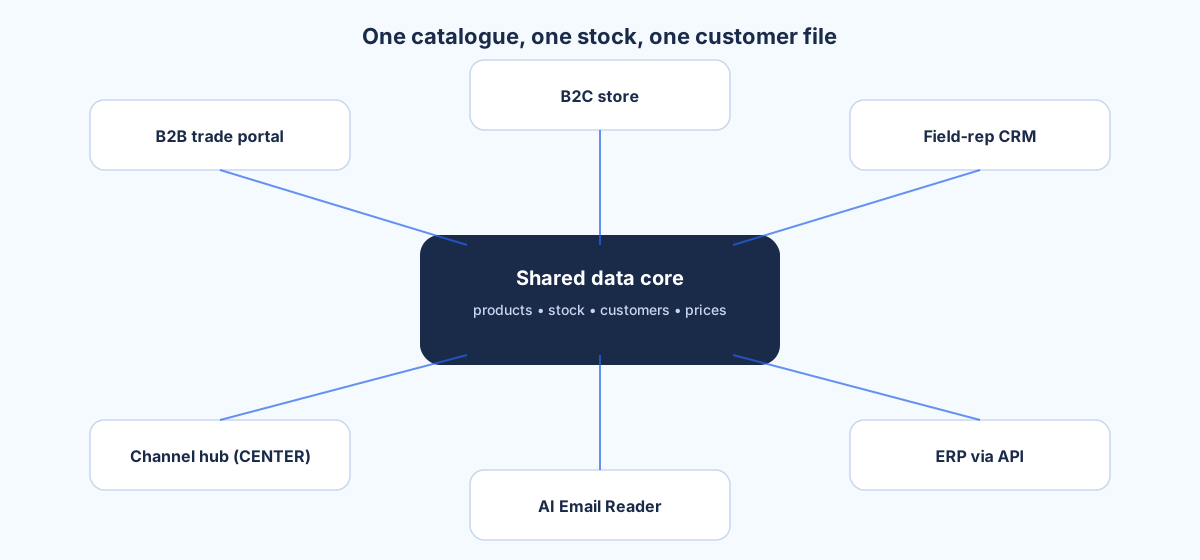
If your online ordering shows one stock figure and the warehouse holds another, you will oversell — and every oversell ends in an apologetic call, a cancellation or a partial shipment. Each of those costs goodwill and the handling already spent on an order that will not complete cleanly. The fix is not more stock-taking; it is one stock figure shared by every channel, so the B2B portal, the B2C store and the field reps are all reading the same number that the warehouse works from. When the catalogue, availability and orders sit in a single system feeding your ERP through one integration, the gap that produces drift is closed by design rather than reconciled after the fact.
Leak 5: The time-cost of quoting from spreadsheets
Building a quote by hand — opening a price spreadsheet, applying the customer's discount, checking stock, formatting a document — takes a surprising amount of a skilled person's day, and slow quotes lose deals to whoever answered first. The margin leak here is partly the labour and partly the orders that cool off while the customer waits. When pricing and availability are already in the system, a quote or an offer becomes a few clicks that produce a document with the correct customer prices, and it can be turned into a live order the moment the customer accepts. Fast, accurate quoting protects both the margin on the labour and the deals that used to slip away in the gap.
Leak 6: Missed reorders because nobody nudged the customer
A steady customer stops ordering and, because no one is watching account activity, three months pass before anyone notices they have been buying elsewhere. Those are not lost sales you competed for and lost — they are sales you gave up by not paying attention. When order history and customer activity sit in a field-rep CRM inside the platform, a quiet account is visible, and a rep can reach out before the relationship drifts. Reorders are the cheapest revenue a distributor has; missing them because the data was scattered across mailboxes is a leak that a shared view closes almost for free.
Why a single data source plugs these structurally
The pattern across all six leaks is the same: the loss happens in the gap between systems and people, where one person's spreadsheet, another's memory and a third's inbox fail to agree. A single-data-source platform removes the gaps by giving the catalogue, prices, credit rules, stock and order history one home that every channel reads and writes. Because Selldi is all-in-one — B2B portal, B2C store, field-rep CRM and a central offer-and-channel hub feeding your ERP through one API integration — a price change, a credit rule or a stock movement is true everywhere at once, not copied around and hoped to stay in sync. It connects to any ERP via API, including SAP, Microsoft Dynamics 365 and NetSuite, and runs in eight languages and multiple currencies for cross-border trade. The point is not that people become careless-proof; it is that the structure stops depending on everyone being careful all the time.
When software will not fix the leak
Be honest about the leaks a platform cannot touch. If you are buying badly — paying too much to suppliers, holding the wrong stock, missing volume terms — no ordering system will rescue a purchase that lost money before it reached your shelf. If you are underpricing freight, absorbing delivery costs you should be charging, or setting list prices below what the market would bear, that is a commercial decision, not a process gap, and software will only help you make the wrong decision faster and more consistently. A platform enforces the rules you set; it does not tell you the rules are wrong. Plug the process leaks so you can see your true margin clearly, then use that clarity to fix the commercial ones — which remain a management job, not a software one.
If you want to see how one shared system handles prices, credit limits and stock in practice, the quickest test is to click through a live one at demo.selldi.pl/showcase and watch where the manual gaps used to be.
Frequently asked questions
Isn't margin mostly about the price list, not the process?
The price list sets your intended margin; the process decides how much of it you actually keep. Order-entry errors, off-the-books discounts, bad debt and cancellations all erode the intended margin after the price is set. Fixing the process is usually where the recoverable money is, because those leaks are quiet and rarely appear as a named cost.
How does enforcing a credit limit actually work in a platform?
The system counts a customer's outstanding, unpaid orders and checks each new order against their limit at the moment it is placed. If the limit would be exceeded, the order is blocked or flagged for review, evenly for every account. That turns a number nobody enforces into a hard control, so credit stops leaking through orders that should have paused.
We give discounts to keep customers happy — won't a system make us rigid?
You keep giving discounts; you just record them as rules with a reason instead of verbal one-offs. That means the same customer gets the same treatment from any rep, and you can finally see the true margin per account. The goal is consistency and visibility, not removing your ability to negotiate.
What causes stock drift and how does one figure fix it?
Drift happens when an online channel and the warehouse hold separate stock numbers that fall out of sync, so you oversell and then cancel. A single-data-source platform shares one availability figure across the B2B portal, B2C store and reps, fed from the same system as the warehouse and ERP. The gap that produces drift is closed by design rather than reconciled after every mismatch.
Which margin problems will a platform NOT solve?
It will not fix buying badly — overpaying suppliers or holding the wrong stock — because that loss happens before goods reach you. It also will not rescue underpriced freight or list prices set too low, which are commercial decisions, not process gaps. A platform enforces the rules you set and shows you your true margin; deciding the rules are right remains a management job.