Author: Selldi
Channel Price Rules: Marketplace Prices Computed From the Net Wholesale Price

A supplier raises its price list by a few percent. In the ERP the change is live the same day; in the B2B platform too, because it reads from the ERP. On the marketplace the price stays where it was until somebody remembers, or until a repricing tool reacts to something that has nothing to do with your cost. For a few days or weeks every marketplace sale goes out at a margin nobody intended.
The fix is not more discipline. It is to compute channel prices from the number that actually moves when costs move: the net wholesale price in the ERP. That is what channel price rules in Selldi CENTER do.
One rule per channel, computed from wholesale

Each channel has its own tab: the B2C store, Allegro, Erli, Amazon. A rule describes how the channel price derives from the net wholesale price. A product without a rule keeps the retail price it had in the ERP, so switching the mechanism on does not change anything overnight by accident. Prices are recalculated nightly, and a “preview changes” step shows exactly which prices would move before you apply anything.
Overrides with a name on them
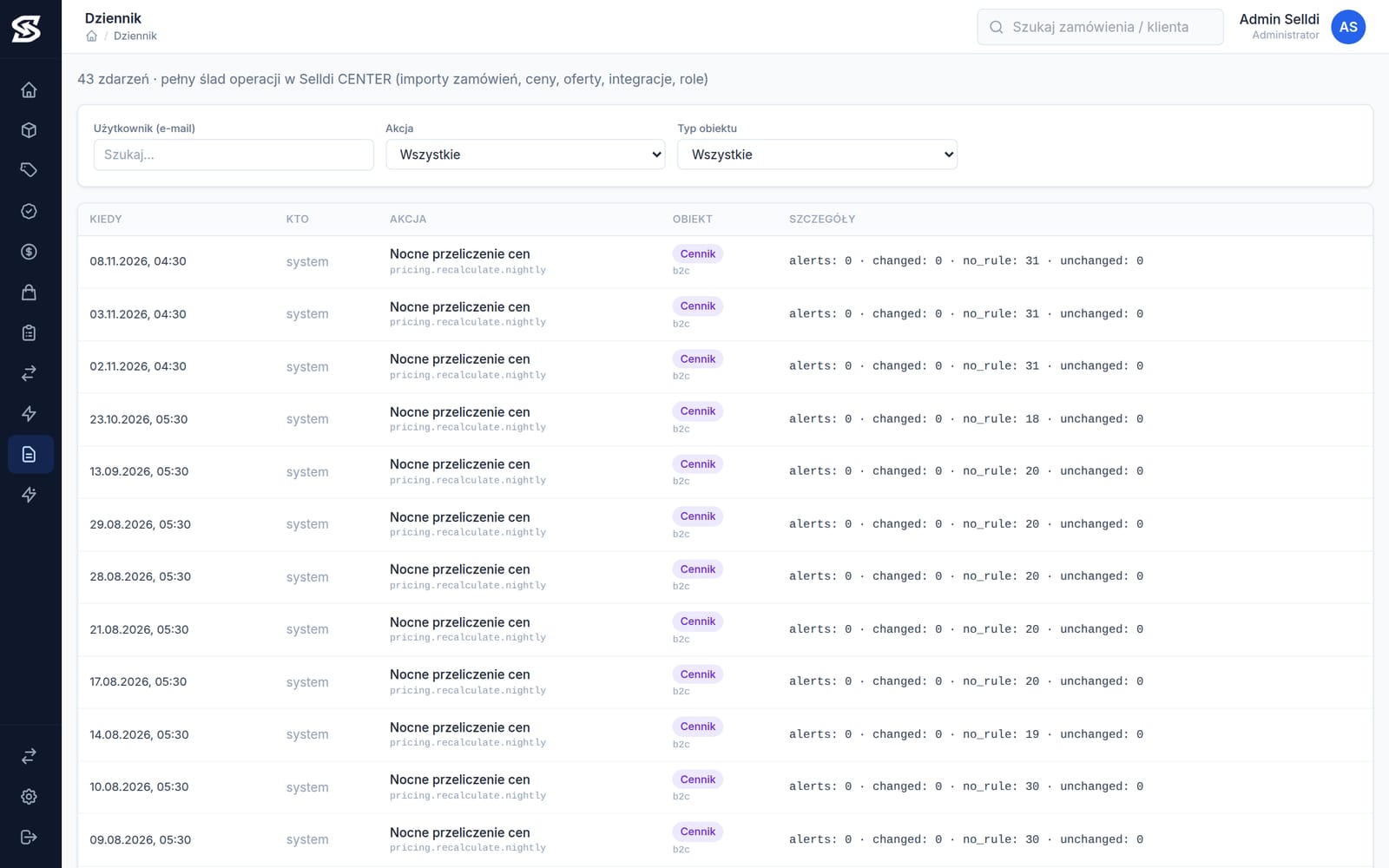
Rules cover the normal case; exceptions are the end-of-line clearance, the competitor you decided to match for a month, the product you want to use as a traffic magnet. A manual override for a single product always beats the rule and records who set it, when and why. Six months later nobody has to guess where that price came from. The operations log shows every nightly recalculation, so after a price-list change you can see when the new prices reached the channels.
What the rule does not know
A price rule is as good as the assumptions you put into it. It does not know your marketplace fees, your delivery cost per parcel or the margin you want on a given category; you enter those as the rule’s parameters. It is also not a competitor-watching repricer. If your marketplace strategy is a daily price race, CENTER will not run it for you. Its job is narrower: keep every channel price anchored to your cost, and make exceptions visible.
In the B2C store a separate consumer-law mechanism applies on top: the product card computes and displays the lowest price of the last 30 days before a discount, as required by the EU Omnibus rules, regardless of how the current price was set.

How it looks in Selldi
CENTER sits on the same database as the B2B platform and the B2C store, so the net wholesale price that feeds the rules is the same one wholesale buyers see in their panel. Set-up follows a fixed order: channels and stock buffers first, then price rules with a preview, then the choice of products per channel. From then on a price-list change in the ERP flows to every channel overnight, and the only prices that stay put are the ones somebody deliberately overrode.
Frequently asked questions
What happens to a product that has no price rule?
It keeps the retail price it had in the ERP. Rules only apply where you define them, so enabling the mechanism does not change prices by accident.
Can I set a price for a single product by hand?
Yes. A manual override for a product always beats the rule and records the author, the time and a note. The operations log shows nightly recalculations as well.
Is this a competitor repricing tool?
No. Channel price rules anchor every channel price to your net wholesale price and make exceptions visible. They do not watch competitors’ prices.