Author: Selldi
One Catalogue for Marketplaces, B2C and Wholesale: Stock Buffers per Channel

Most wholesalers do not plan to become marketplace sellers. It happens sideways: someone lists a few slow movers on a marketplace, it works, the list grows, and a year later the company runs three channels from three tools. The symptom everybody recognises is the Friday afternoon phone call: the last twenty bags of adhesive were sold at the same time to a regular wholesale buyer and to three marketplace shoppers, and someone has to apologise.
The root cause is architectural, not human. Each channel keeps its own copy of the stock, and the copies drift. This article shows the alternative used in Selldi CENTER: marketplaces, the B2C store and wholesale read from one catalogue, each channel sees that stock minus a buffer, and every order lands in the same list and in the ERP.
One catalogue, every channel’s price in one row
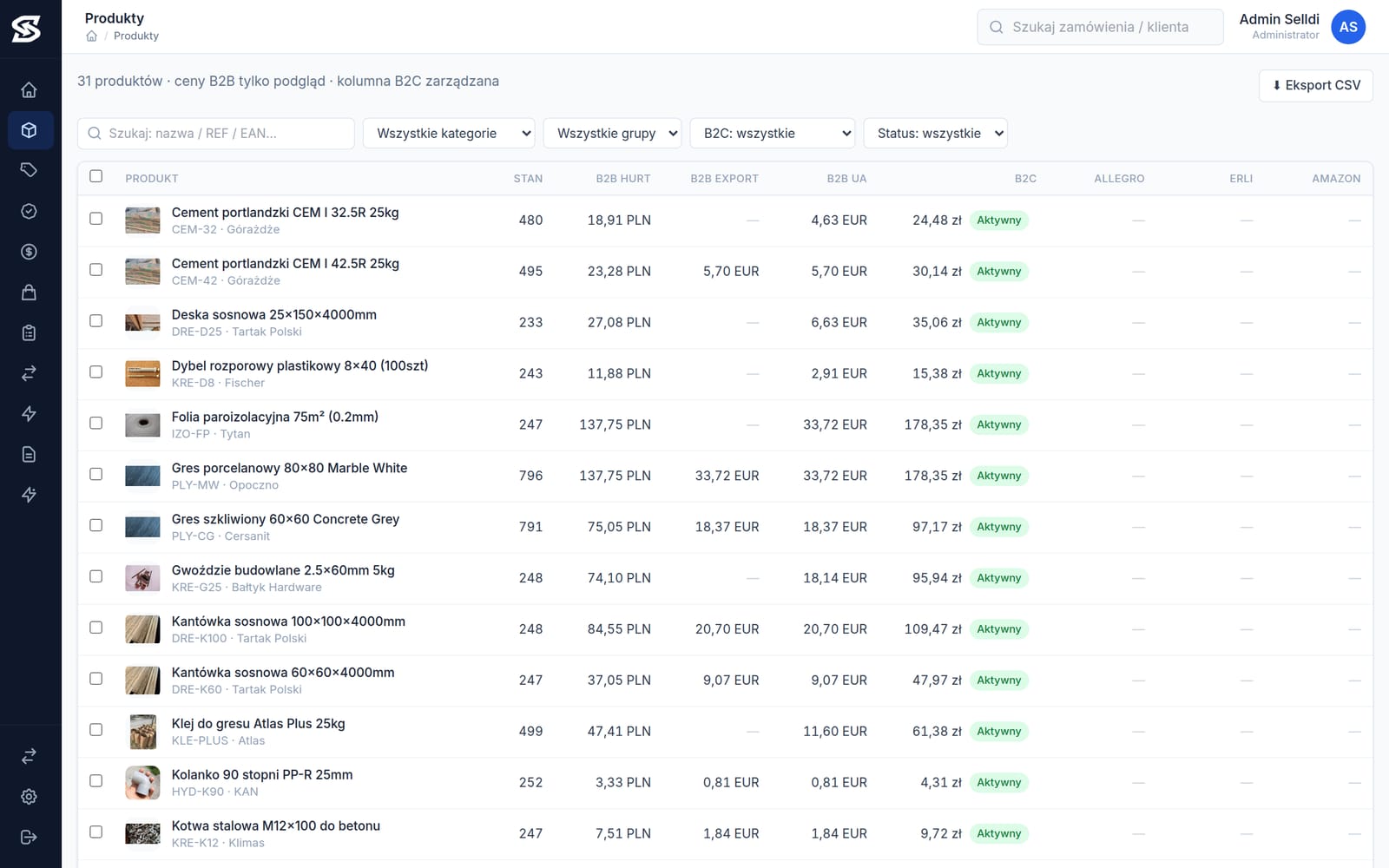
The starting point is a single product list fed by the ERP. Every row shows the stock, the net wholesale price, export prices in euro, the B2C price and columns for Allegro, Erli and Amazon. The wholesale prices are shown for reference only, because they are managed in the B2B platform and the ERP. CENTER manages the retail and marketplace columns. For the team this replaces the spreadsheet in which somebody compared the marketplace price with the wholesale list every Monday.
Stock buffers: how not to sell what is already gone
The usual marketplace problem for a wholesaler is the delay between a sale and the stock update. A buyer orders in the B2B panel, and the marketplace offer still shows the old quantity. A stock buffer solves this in the simplest possible way: for every channel you decide how many units stay out of its reach. With 100 units in stock and a buffer of 10, the channel sees 90, and the last ten remain for wholesale buyers.

The buffer is set per channel, so you can protect wholesale more strongly where retail sells fastest. The screen also shows that an existing store on another platform can be attached as one of the channels, which matters for companies that are not ready to close a shop that still works.
One order list and the ERP
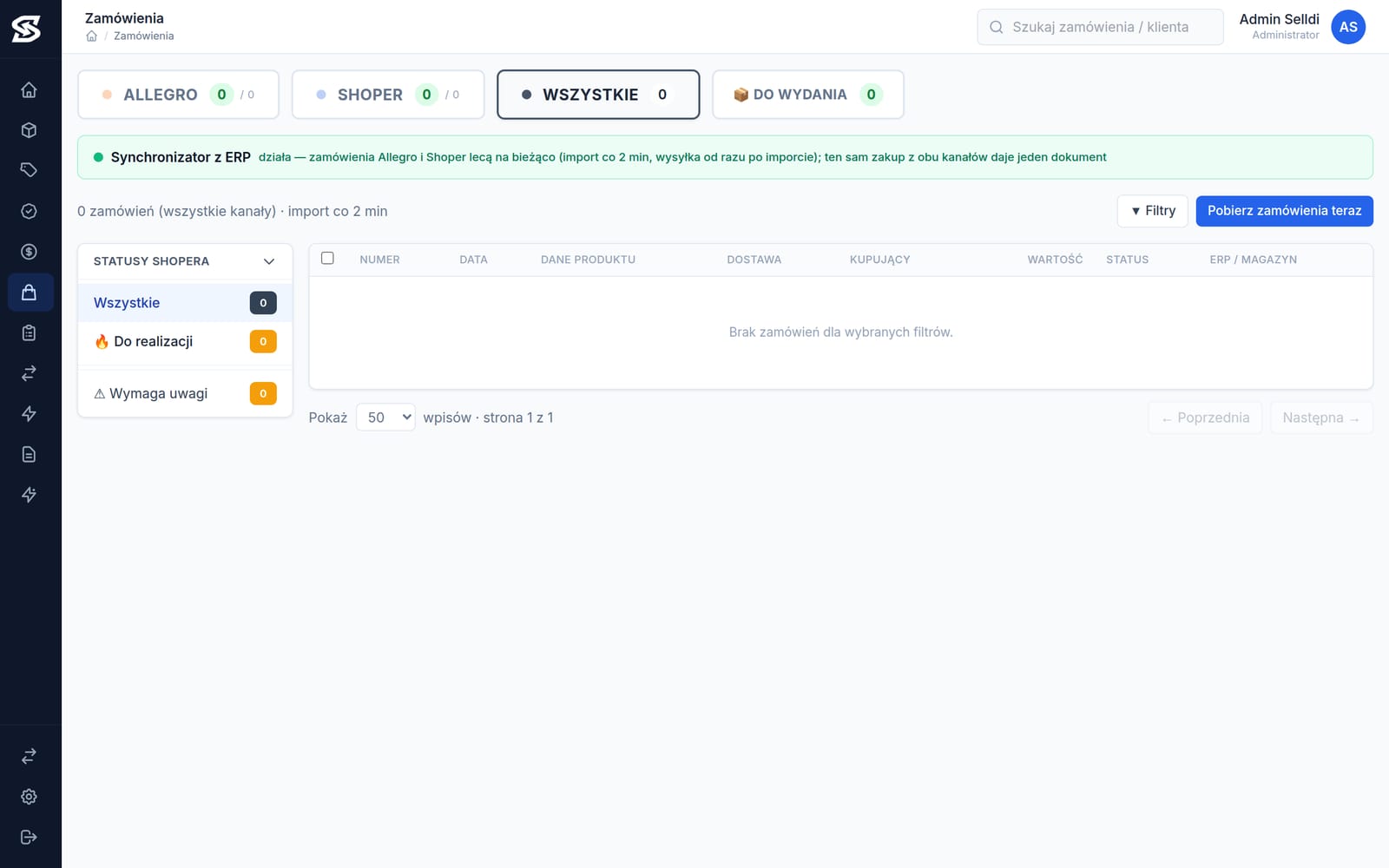
Orders from all channels arrive in one list with filters such as “to fulfil” and “needs attention”. A synchroniser passes them to the ERP; the same purchase arriving from two channels becomes one document, not two. On top of the list sit simple automations of the form “when X then Y”: a large order gets flagged, an order that failed to reach the ERP gets a higher priority, an order from a given marketplace gets a note. Every rule execution is logged, so the warehouse knows why an order jumped to the top.
When this is the wrong tool
If you sell retail only and have no wholesale buyers, a buffer that protects wholesale is pointless, and a dedicated marketplace integrator with dozens of niche platforms, packing assistants and label printing will serve you better. CENTER covers the B2C store, Allegro, Erli, Amazon and an attached external store. It does not calculate the profitability of a channel and will not decide what is worth listing. On Amazon it lists offers on existing product pages matched by EAN; a new product page is created on the Amazon side.
How it looks in Selldi
CENTER is one module of Selldi, an all-in-one sales platform in which the B2B platform, the B2C store, the CRM and the ERP integration share one database. Implementation starts with channels and buffers, then price rules, then the choice of which products go to which channel. From that moment the wholesale buyer in the B2B panel, the shopper in the B2C store and the marketplace customer all see stock from the same catalogue, each reduced by what the wholesaler decided to keep back.
Frequently asked questions
How does a stock buffer protect wholesale buyers?
For each channel you set the number of units held back. With 100 units in stock and a buffer of 10, the marketplace sees 90 and ten stay for wholesale orders. Buffers are set separately for the B2C store and every marketplace.
Do marketplace orders reach the ERP?
Yes. Orders from all channels land in one list in CENTER and are passed to the ERP by a synchroniser. If the same purchase arrives from two channels, it becomes a single document.
Does CENTER replace a marketplace integrator?
For a wholesaler with an ERP and B2B buyers it usually does: channels, stock, prices and orders run on the same database as the B2B platform. For retail-only sellers on many niche marketplaces, with heavy packing and labelling needs, a dedicated integrator remains the better choice.