Field Sales Reps and B2B E-commerce: Allies, Not Rivals

A B2B portal does not replace field sales reps; it removes the part of their job nobody misses. When routine reorders and order retyping move to self-service, reps stop being clerks and become advisors, prospectors, and the people who save accounts before they drift to a competitor. Selldi is an all-in-one sales system for wholesalers and distributors that keeps the rep at the centre: it includes a built-in field-rep CRM (accounts, activities, a shared mailbox, a training area), lets reps place orders on behalf of customers under the same enforced rules as the customers themselves, and uses an AI Email Reader to turn the order emails reps used to retype into ready-made drafts. The fear that digital and reps are rivals comes from imagining the portal as a replacement for the salesperson, when in practice it is a replacement for the salesperson's worst hour of the day. The businesses that get this right introduce the portal as the rep's own tool, not as the thing coming for their job.
The fear is real, and it is aimed at the wrong target
When a distributor announces a B2B portal, the sales team hears one thing: automation is here to make us cheaper to replace. It is an honest fear and worth taking seriously, because a rep whose entire value was keying in the same order every Tuesday is, in fact, doing work a portal does better. But that was never where a good rep's value lived. Their value is in knowing that the buyer at account 214 is about to lose a big contract and needs different terms, that the new purchasing manager at account 330 prefers email to phone, that a competitor just undercut you on fasteners and you have three days to respond. None of that is typing.
The portal comes for the typing, not the judgement. Once you separate those two things, the rivalry dissolves. The retyping, the "can you just place my usual order", the copying of a customer's emailed spreadsheet into the system by hand, all of that is pure friction that burns a rep's day and earns nobody anything. Hand it to the machine and you have not shrunk the rep's role, you have handed them back the hours they were losing to it.
What the rep actually does once the portal lands
In practice, three things expand to fill the freed-up time. The first is advisory selling. A rep who is not racing to key in twenty routine orders can sit with a customer and talk about what they are not yet buying: the adjacent product line, the volume break they are one pallet short of, the seasonal stock-up that saves them money later. This is the conversation that grows an account, and it only happens when the rep has room to have it.
The second is prospecting. Every wholesaler has a list of merchants they have never properly called on because the existing customers ate all the hours. When the portal absorbs the maintenance work on current accounts, that list finally gets worked. The third is account rescue. Somewhere in your customer base right now is an account whose order frequency has quietly halved, and nobody noticed because everyone was busy processing the accounts that were still ordering. A rep with a CRM in front of them, showing activities and order patterns, spots the drift and makes the call before the account is gone. That single save often pays for the whole system.
The rep and the portal, working the same accounts
The point is not that customers self-serve and reps disappear; it is that both work the same accounts through the same system. In Selldi a rep can place an order on behalf of a customer, which matters more than it sounds. A buyer who is comfortable on the phone but not on a website is not left behind, the rep enters it for them, and it lands in exactly the same place as a self-service order. And critically, the rep's order runs under the same enforced rules as the customer's own: a credit limit is a credit limit, a customer with cash-on-delivery switched off cannot have it switched back on by phoning a friendly rep. The controls live in the system, not in whoever happens to be placing the order.
That is a bigger deal than it looks. In a lot of businesses, the informal way around a delivery restriction or a credit hold is to ask a rep to "just put it through for me". When the rules are enforced regardless of who clicks the button, that loophole closes, and the rep is no longer the person who has to choose between a policy and a relationship. Within their own market, a rep sees the customers, orders and offers that belong to them, and the same market boundaries that protect pricing also keep them focused on their patch rather than drowning in the whole company's data.
Where the AI Email Reader fits
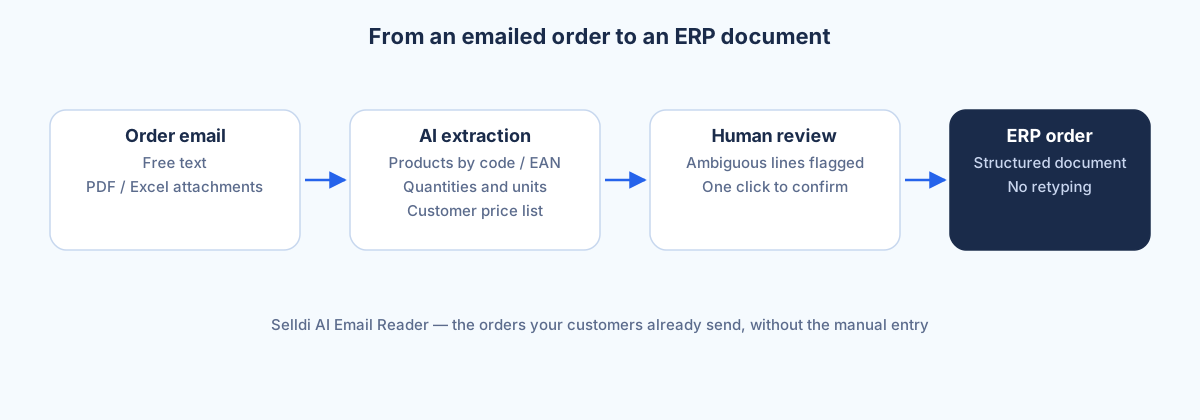
A large share of wholesale orders still arrive as emails: a spreadsheet attached, a photo of a handwritten list, a few lines in the body of a message. Historically a rep or a back-office clerk retyped every one of those into the system, which is slow, error-prone, and exactly the kind of work that makes people fear automation for the wrong reasons. Selldi's AI Email Reader takes those inbound emails and turns them into draft orders a human confirms, so the retyping simply stops.
Notice who benefits. The rep does not lose the customer relationship, because the customer still emails their trusted contact the way they always did. What disappears is the twenty minutes of transcribing that email into order lines. The rep reviews the draft, checks it against what they know about the account, confirms it, and moves on to the advisory conversation they never used to have time for. The email channel that customers love does not go away; the manual labour behind it does.
Introducing it to a sales team without a fight
Change management with reps is mostly about framing and incentives, and it is easy to get wrong. Two things tend to decide whether the team adopts the portal or quietly sabotages it:
- Introduce the portal as the rep's tool, not the customer's replacement for the rep. If a rep believes an order placed online is an order taken away from them, they will steer customers away from it. If they believe the portal is what lets them stop retyping and start selling, they will push it. The message and the CRM should both say: this is yours, it works your accounts, it makes your number easier to hit.
- Get attribution and commission thinking straight before launch, not after. The question 'who owns a portal order' will come up on day one, and if the answer is 'nobody, so nobody gets paid', the team learns fast that digital orders cost them money. Whatever your model, the fair instinct is that an order from a rep's account, whether the customer clicked it or the rep entered it, is still the rep's account. Decide it deliberately; do not let it default to a grievance.
Handled this way, the portal becomes the thing reps recommend rather than resist. The best salespeople work it out quickly: the account that self-serves its boring reorders is the account that has more time and goodwill for the conversation that actually grows the relationship.
When a rep-free self-service model fits better
It would be dishonest to claim every distributor needs a field sales force. If your product is simple, your prices are published and flat, and your customers know exactly what they want, a pure self-service model without reps can be the leaner, cheaper choice, and layering a sales team on top would just add cost to a transaction that did not need a human in it. High-volume, low-touch, commodity distribution is often best run as a clean portal where the customer does everything themselves and the business competes on price, stock and delivery.
Reps earn their keep where the sale is consultative: complex catalogues, negotiated pricing, relationships that took years to build, customers who buy more when someone helps them see what they are missing. In that world the portal and the rep are not rivals at all, they are two halves of one motion, and Selldi is built to run both, the self-service B2B portal and B2C store on one side, the field-rep CRM, on-behalf ordering and AI Email Reader on the other, over shared products, stock and customer data, with ERP integration to any system via API, including SAP, Microsoft Dynamics 365 and NetSuite. The most convincing way to see how a rep and a portal share an account is to walk your own sales team through the working demo at demo.selldi.pl/showcase and let them place an on-behalf order under the same rules a customer would.
Frequently asked questions
Does a B2B portal make field sales reps redundant?
No. A portal absorbs the routine reorders and order retyping, not the judgement, relationships and negotiation that make a good rep valuable. In practice reps shift toward advisory selling, prospecting new accounts and rescuing customers whose orders are quietly declining. Selldi is designed to keep the rep central, with a built-in CRM and the ability to order on a customer's behalf, rather than to replace them.
Can a sales rep place orders for a customer in Selldi?
Yes. A rep can place an order on behalf of a customer, which matters for buyers who prefer the phone to a website, and the order lands in the same place as a self-service one. Crucially, the rep's order runs under the same enforced rules as the customer's own, including credit limits and delivery permissions. There is no bypassing a restriction by asking a friendly rep to put it through.
How does the AI Email Reader change a rep's day?
Many wholesale orders arrive as emails with an attached spreadsheet or a few lines of text, and historically someone retyped each one into the system. Selldi's AI Email Reader turns those inbound emails into draft orders that a human confirms, so the transcribing stops. The customer still emails their trusted rep as before; what disappears is the manual keying behind it, freeing the rep for higher-value work.
Who 'owns' an order placed through the portal, the rep or the system?
That is a policy decision every distributor should make deliberately before launch rather than let default into a grievance. The fair instinct is that an order from a rep's account, whether the customer clicked it themselves or the rep entered it on their behalf, is still that rep's account. Settling attribution and commission thinking up front is what keeps a sales team pushing the portal instead of quietly steering customers away from it.
How do you introduce a portal to a sales team without resistance?
Frame the portal as the rep's own tool that ends retyping and frees time to sell, not as the customer's replacement for the rep. Reps who see online orders as work taken away from them will steer customers off the portal; reps who see it as what lets them stop clerking and start advising will promote it. Getting commission and attribution straight before launch removes the other main source of pushback.
When is a self-service model without reps a better fit?
If your product is simple, prices are published and flat, and customers know exactly what they want, a pure self-service portal can be leaner and cheaper, and a sales force would just add cost. High-volume, low-touch commodity distribution often runs best that way. Reps earn their keep where the sale is consultative, with complex catalogues, negotiated pricing and relationships that grow when someone helps the customer see what they are missing.