AI Order Entry: From Emailed Orders to ERP Documents

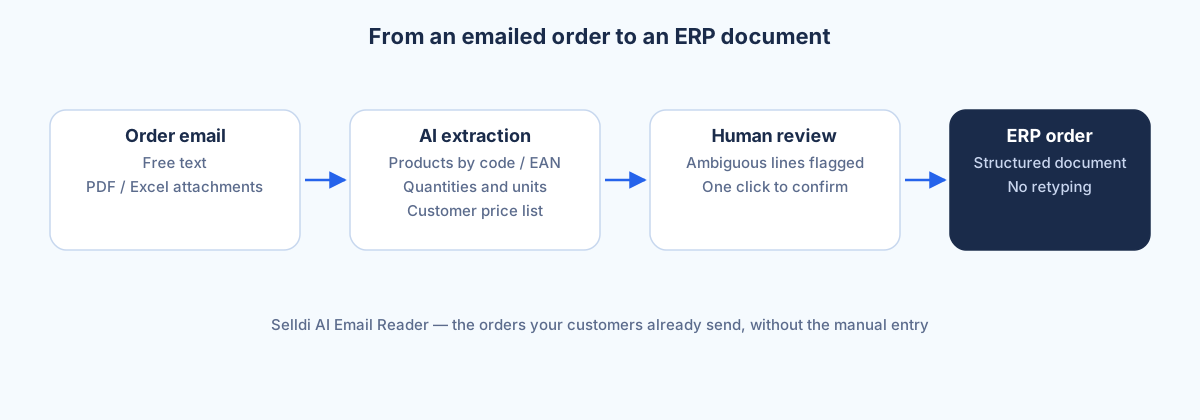
AI order entry is the process of reading a free-text order email, and its attachments, and turning it into a structured order in your ERP automatically, instead of a rep retyping it by hand. Selldi does this through its AI Email Reader: it reads the body of an order email including PDF and Excel attachments, extracts the customer, the products (matched by code, EAN or name), the quantities and the units, applies that customer's individual price list, and creates a ready order in the ERP, with a human-review step before anything is committed. It connects to any ERP via API, including SAP, Microsoft Dynamics 365 and NetSuite. In wholesale, where a large share of B2B orders still arrives by email, this removes one of the most tedious and error-prone daily jobs in the business, while keeping a person in control of anything ambiguous.
It helps to picture the reality first. A Monday morning at a wholesaler: forty emails in the shared inbox, half of them orders. One is three lines typed in the body. One is a PDF purchase order from a customer's own system. One is a spreadsheet a buyer has been maintaining for years, with their own column names and their own product descriptions. A rep opens each one and retypes it into the ERP, line by line, cross-checking codes and prices. That is the job the AI Email Reader is built to take over.
Why email ordering never dies in wholesale
Every few years someone predicts that portals will kill the email order, and every year the email order survives. The reason is simple: for the buyer, email is frictionless. They already know what they want, they have a template or a habit, and sending it takes ten seconds. Asking a long-standing customer to log into a portal, navigate a catalogue and rebuild an order they could have emailed is asking them to do more work for your convenience, and many of them will quietly decline.
So the practical truth in most wholesale businesses is a mix. Some customers adopt the B2B portal happily. Others, often the largest and oldest, keep emailing, because that is how their own procurement works and they are not going to change it for a supplier. A large share of B2B orders still comes in as free text, PDF or spreadsheet, and that share is not going to zero. The question is not how to eliminate email orders; it is how to stop paying a person to retype them.
What manual retyping really costs
The obvious cost is time. Every emailed order is a few minutes of a rep's attention, and across a full inbox that is hours a day of skilled staff doing data entry instead of selling. But the time is the smaller problem. The bigger one is errors, and in wholesale they hide at the unit level. A line that reads "25s" of a product, is that 25 bags, 25 metres, or 25 cartons? Retype it under Monday-morning pressure and it is easy to enter the wrong unit, and now the customer receives the wrong quantity, the stock figure is off, and someone spends an afternoon untangling it.
There is a third cost that rarely gets counted: latency. An email that lands at nine but is not retyped until the afternoon is an order that ships a day later than it needed to, and in a competitive market that delay is felt. AI extraction compresses that gap, the order is parsed as soon as it arrives, so the human step is a quick review rather than a from-scratch transcription. Time saved, errors caught, orders out faster: those are the three things the manual process quietly costs you every day.
How AI extraction works in practice
The AI Email Reader does not just "read text". It reads the email body and opens the attachments, PDF purchase orders and Excel spreadsheets included, and pulls out the structured meaning: who the customer is, which products they want, how many, and in which unit. Crucially, it does not take the product names at face value. It matches each line against your actual catalogue by product code, EAN or name, so a customer's idiosyncratic description resolves to the correct SKU in your system rather than a guess.
Then it prices the order the way you would. Because Selldi holds each customer's individual price list, the extracted lines are costed at that customer's real prices, not the list price, so what the rep reviews already looks like a finished order. Lines that match cleanly flow straight through. Anything the system is not confident about, an ambiguous unit, a product it cannot match with certainty, a quantity that looks unusual, is flagged as an exception for a human to resolve. The rep is no longer transcribing; they are reviewing a mostly-complete order and settling the few lines that need judgement.
What happens with ambiguous lines
This is where the human-review step earns its place, and why it is deliberately not removed. Take the "25s" example. Rather than silently guessing, the AI Email Reader surfaces that line as an exception: it has matched the product but is not certain whether the unit is bags or metres, so it asks a person to confirm. The same happens when a product description could match two SKUs, or when a quantity is far outside that customer's normal pattern. The system is confident where it should be and cautious where it should be.
The result is a division of labour that fits how wholesale actually works. The machine handles the volume, the dozens of clean lines that used to eat a morning, and the person handles the judgement, the handful of lines where a mistake would matter. Nobody is asked to trust a black box, because the order does not commit to the ERP until a human has looked at it. You get the speed of automation without giving up control over the orders that pay your bills.
Security and where the data stays
An order email carries real commercial data: who is buying, at what prices, in what volumes. That is why the AI Email Reader is designed to work inside your own order flow rather than scattering data across disconnected tools. The extracted order moves from the inbox, through review, into your ERP, one controlled path, connecting to any ERP via API including SAP, Microsoft Dynamics 365 and NetSuite. Keeping the process contained is not a nice-to-have in wholesale; the pricing in those emails is exactly the information you do not want leaking sideways, and a single, reviewable flow is how you keep it in your hands.
When not to bother
AI order entry is not for everyone, and it is fair to say so. If your order volume is genuinely small, a handful of emails a week, the manual process is not costing you enough to be worth automating, and a rep can comfortably keep up. Likewise, if you have already moved essentially all of your customers onto the B2B portal and email orders have dried up, there is little left for the AI Email Reader to do; the problem it solves has already been solved a different way. Where it pays off is the common middle ground: a steady stream of email, PDF and spreadsheet orders alongside your portal, enough of them that retyping is a real daily cost and unit-level mistakes are a recurring risk. That is most wholesalers, which is exactly why it exists.
Frequently asked questions
How accurate is AI order entry?
The AI Email Reader matches each line against your real catalogue by product code, EAN or name and applies the customer's own price list, so clean lines resolve reliably. Where it is not confident, an ambiguous unit, an uncertain product match or an unusual quantity, it flags the line as an exception instead of guessing. Because a human reviews the order before it reaches the ERP, the practical accuracy is high while genuine mistakes get caught rather than shipped.
What file types can it read?
It reads the free-text body of the order email as well as attachments, specifically PDF purchase orders and Excel spreadsheets, which are the two formats wholesale orders most commonly arrive in. It extracts the customer, products, quantities and units from all of them and matches the products to your catalogue. That means a buyer can keep sending orders in whatever format they already use, without being forced onto a new system.
Does this replace the B2B portal?
No, it complements it. Some customers happily use the Selldi B2B portal, while others, often the largest and longest-standing, keep ordering by email, and the AI Email Reader handles that second group without forcing anyone to change. The portal and the AI email flow feed the same catalogue, stock and ERP, so you capture orders however customers prefer to send them. You get portal self-service and automated email orders in one system rather than choosing between them.
How does the order land in the ERP?
After the AI Email Reader extracts and prices the order and a person reviews any flagged lines, the finished order is created in your ERP through Selldi's API integration. Selldi connects to any ERP via API, including SAP, Microsoft Dynamics 365 and NetSuite, so the structured order becomes a proper document in the system you already run. Nothing is committed to the ERP until the human-review step is complete.
Is the data in order emails kept secure?
The AI Email Reader is designed to work inside your own order flow, moving each order along one controlled path from inbox, through review, into your ERP, rather than spreading commercial data across disconnected tools. Since order emails contain customer pricing and volumes, keeping the process contained is central to how it is built. That single, reviewable flow is how the sensitive information in those emails stays within your business.