How to Choose a B2B E-commerce Platform: a Checklist

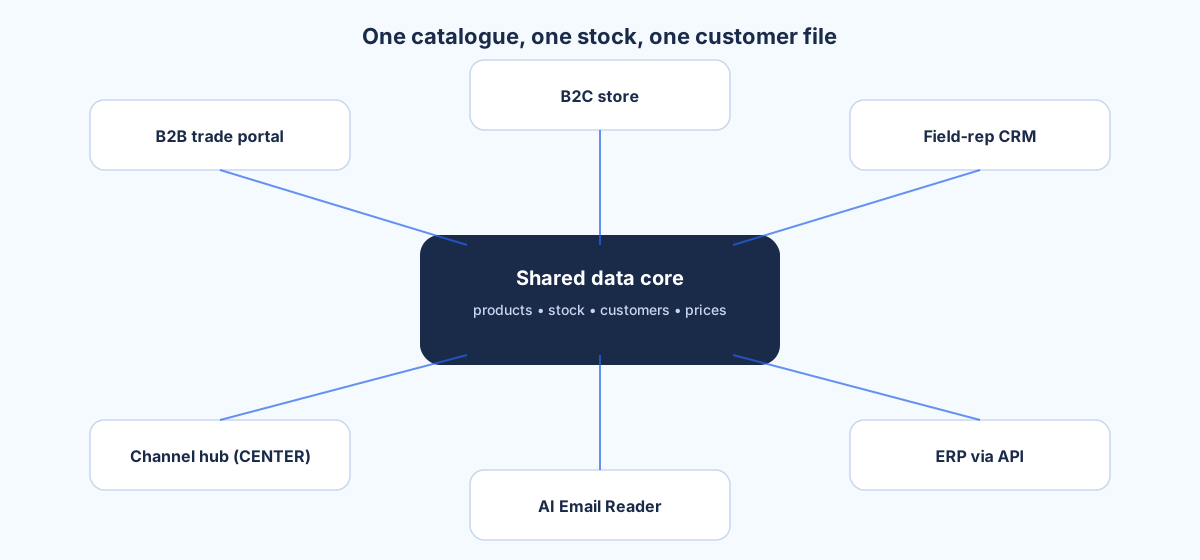
To choose a B2B e-commerce platform, evaluate it against how wholesale actually works, not how a consumer webshop works: it must handle customer-specific pricing in the right currency per market, enforce credit terms, allow fast CSV and EAN ordering, integrate with your ERP through an API, and give your reps a shared view of every account. Then pressure-test each vendor with a few blunt questions, watch for a handful of red flags, and score the shortlist on the things that matter to your business rather than the demo's shiniest screen. Selldi is one option in this space, an all-in-one sales system for small and mid-sized wholesalers and distributors in Europe that puts the B2B portal, a B2C store, a field-rep CRM, the CENTER channel hub, an AI Email Reader and ERP integration in one place. The right choice, though, depends on your size and goals, and this checklist is here to help you make it honestly, whichever way it points.
Start from what wholesale actually needs
Most e-commerce platforms are built for a shop selling one price to everyone. Wholesale is the opposite: every customer can have their own price, their own terms, their own currency, and half your orders arrive as a list of codes rather than someone browsing a catalogue. If you evaluate a platform on how pretty its product pages are, you will miss the things that decide whether it survives contact with your real business. Judge it on the mechanics of B2B.
Before you look at a single demo, write down how your business really runs. How many price levels do you have? Do you sell across borders in more than one currency? Do you give credit, and does anyone enforce the limits today? How do orders come in now, and how many are retyped by hand? Which back-office system holds the truth about stock and invoices? Those answers are your requirements, and they are more useful than any vendor's feature list.
The must-haves for a wholesaler
There is a core set of capabilities that a serious B2B platform has to cover. Miss one and you will end up working around it forever, which usually means the manual process you were trying to escape survives in a spreadsheet next to the new system. Use this as your baseline, then add whatever is specific to your trade.
- Customer-specific pricing, including price lists per market with the correct currency, so each buyer sees their own prices at login without a quote.
- Credit terms that are actually enforced by the system, so an over-limit order is stopped, not just noted.
- Fast ordering for buyers who know what they want: paste a CSV or list of codes, and scan an EAN barcode from a phone in the warehouse.
- ERP integration through an API to whatever runs your back office, including SAP, Microsoft Dynamics 365 and NetSuite, so stock and documents stay in sync.
- Multi-language support for export, a field-rep or CRM side so people on the road share the same account view, and the option to run a B2C store on the same catalogue.
- AI order capture that reads an order out of a customer's email and puts it into the system without retyping.
That last group matters more than it looks. A platform that only does the buyer-facing portal leaves your reps blind and your emailed orders manual. The value of an all-in-one system is that pricing, stock, the rep's view, the export languages and the AI email capture are the same data, not five tools you have to reconcile.
Questions to ask every vendor
Demos are designed to look good. The way to see past them is to ask questions the polished screens do not answer, and to watch how comfortable the vendor is answering them. Four questions do most of the work. First: who actually does the implementation, your team or ours, and what does that cost in time and money? A platform is only as good as the people who set it up, and "you configure it yourself" is a very different offer from "we set it up with you".
Second: what happens to our data? Where does it live, who can see it, and if we leave, can we get all of it out in a usable form? Third: how are updates shipped, and can a change break our store overnight? You want a vendor who patches everyone's system safely, not one where every update is a gamble. Fourth, and this is the one that separates serious vendors from the rest: can we try it with OUR products, prices and customers before we commit? A vendor confident in their product will let you load your real catalogue into a demo. A vendor who only shows you their sample data is hiding how the system behaves under your reality.
Red flags
Some warning signs tell you a platform was not built for wholesale, or that the commercial model will bleed you over time. The first is B2B sold as a paid add-on tier bolted onto a consumer webshop. If customer-specific pricing and credit terms are an upsell rather than the foundation, the product's heart is retail and the B2B parts will always feel grafted on. The second is per-order commissions or transaction fees. In wholesale your order values are large and your margins are managed to the point; a cut of every order is a tax on your own business that grows exactly as you succeed.
The third red flag is a platform where price lists are managed outside the system, in spreadsheets you upload and re-upload. If your prices do not live in the platform, the platform is not really running your sales; it is a display window for a process that still happens by hand. The fourth is any vendor who cannot give you a straight answer to "can we try with our own data". Vagueness there usually means the answer is no, and no is a reason to walk away.
A simple way to score the shortlist
You do not need a complicated spreadsheet, but you do need to compare on the same terms so the loudest demo does not win by default. Take your must-have list, mark each one as essential or nice-to-have, and score every platform on the essentials first. A platform that misses an essential is out, regardless of how good the rest looks; there is no point loving a system that cannot enforce your credit limits. Then, among the platforms that clear the essentials, score the nice-to-haves and the softer factors: implementation support, honesty of the vendor's answers, and how the trial with your own data felt.
Weight the trial heavily. The single most predictive thing in this whole process is how the platform behaved when you put your real products and prices into it. Everything else is a promise; the trial is evidence. If one system handled your messy real catalogue calmly and another struggled, that tells you more than any comparison table.
Different sizes need different tools
Here is the honest part. There is no single best B2B platform, because a global manufacturer and a regional distributor have different problems. Large enterprises with complex, unusual requirements often go composable: separate best-of-breed pieces stitched together by a development team, maximum flexibility at the cost of complexity, budget and specialists to run it. If you are that size and you have the people, that route can be right, and a compact all-in-one system may feel constraining.
Most wholesalers are not that size. For a small or mid-sized wholesaler or distributor, the composable route is usually a way to spend a lot of money assembling something that an integrated system already does out of the box. That is where an all-in-one platform fits: one system that covers the B2B portal, the B2C option, the rep CRM, the channel hub, the AI email capture and the ERP link, set up for you rather than assembled by you. Selldi sits deliberately in that segment, for SME wholesalers and distributors across Europe who want everything in one place, a demo-first evaluation with their own products, and an implementation measured in around two weeks rather than months. Whether that is your fit depends on your list above, which is exactly why you wrote it first.
When you have your requirements and your shortlist, the most useful next move is to stop reading comparisons and put your own products in front of a working system, and you can start with the live demo at demo.selldi.pl/showcase or book a walkthrough to see it against your specific setup.
Frequently asked questions
What are the must-have features in a B2B e-commerce platform?
At minimum: customer-specific pricing with per-market currency, credit terms that the system actually enforces, fast ordering by CSV and EAN scanning, and ERP integration through an API. Beyond that, look for multi-language support for export, a field-rep or CRM side, an optional B2C store on the same catalogue, and AI capture of orders from email. Missing one of these usually means a manual workaround survives forever.
What questions should I ask a B2B platform vendor before buying?
Ask who does the implementation and what it costs, what happens to your data and whether you can export all of it if you leave, how updates are shipped and whether they can break your store, and most importantly whether you can trial the system with your own products, prices and customers. A vendor confident in their product lets you load real data; one who only shows sample data is hiding how it behaves under your reality.
What are the red flags when choosing a B2B platform?
Watch for B2B sold as a paid add-on tier on top of a consumer webshop, per-order commissions or transaction fees that grow as you succeed, and price lists managed in spreadsheets outside the system. Also treat any vendor who cannot clearly say yes to trialling with your own data as a warning sign. These usually mean the product was not built for wholesale.
Should an SME wholesaler choose composable or all-in-one?
Large enterprises with unusual requirements and their own developers often go composable for maximum flexibility. For most small and mid-sized wholesalers, that route means spending heavily to assemble what an integrated system already does out of the box. An all-in-one platform like Selldi, set up for you rather than assembled by you, is usually the better fit at SME scale.
How should I score competing B2B platforms fairly?
List your must-haves, mark each as essential or nice-to-have, and eliminate any platform that misses an essential regardless of how good the rest looks. Among the survivors, score the nice-to-haves plus softer factors like implementation support and vendor honesty. Weight the trial with your own data most heavily, because it is evidence rather than a promise.