Best B2B E-commerce Platforms for Wholesalers (2026)

The best B2B e-commerce platform for a wholesaler or distributor in 2026 depends on one thing above all: how complex your operation really is. Enterprises with multi-tier dealer networks, punchout catalogues and heavy ERP dependencies gravitate to OroCommerce, Sana Commerce or Adobe Commerce; fast-moving hybrid B2C/B2B brands lean toward Shopify; and small-to-mid-size wholesalers who want everything working in one system, without an integration team, are increasingly choosing Selldi. Selldi is an all-in-one sales system that combines a B2B ordering portal, a B2C store, a field-rep CRM, a central offer and channel hub, an AI Email Reader and ERP integration, in 8 languages and multiple currencies, connecting to any ERP via API, including SAP, Microsoft Dynamics 365 and NetSuite. This guide walks through the leading options honestly, one platform at a time, with the trade-offs each one asks you to accept.
A quick word on how to read this. There is no single "best" platform, only the best fit for your order volume, your catalogue, your ERP and the size of your team. A distributor selling five thousand SKUs across three countries has different needs than a family wholesaler with two reps and a warehouse. We deliberately avoid quoting anyone's prices here, because vendor pricing changes constantly and each one publishes current numbers on its own site. What matters more is the shape of the platform: who it was built for, and where it starts to hurt.
OroCommerce — built for complex enterprise B2B
OroCommerce is purpose-built for B2B from the ground up. It ships with CRM, quoting and CPQ, RFQ workflows, multi-tier account hierarchies, approval chains and punchout catalogue support under a single licence. If your business genuinely has dealer networks that negotiate their own catalogues, buyers who need multi-step approval before an order goes through, and procurement systems that must connect via punchout, OroCommerce is one of the few platforms designed for exactly that world.
The trade-off is weight. OroCommerce is open-source and flexible, which is another way of saying it expects development resources. Standing it up, configuring the workflows and keeping it maintained is a project, not an afternoon. For a large manufacturer or distributor with an in-house or agency dev team, that is a fair price for the control it gives you. For a lean wholesaler, it is usually more platform than the business can carry.
Sana Commerce — the storefront that lives inside your ERP
Sana Commerce takes a different philosophy: instead of syncing data back and forth, the storefront reads pricing, stock, customer terms and orders live from the ERP. It is built specifically to run on top of SAP or Microsoft Dynamics, so the shop and the ERP are always in agreement by design. For a company that already runs its entire business inside one of those systems and treats the ERP as the single source of truth, that tight coupling is genuinely valuable, there is no reconciliation step and no drift.
That same strength is its constraint. Sana's model makes most sense when you are firmly on SAP or Dynamics and intend to stay there. If your ERP is something else, or you want the sales layer to have a life of its own beyond what the ERP dictates, the fit gets looser. It is an ERP-native tool first and a sales platform second, which is exactly what some distributors want and exactly what others find limiting.
BigCommerce B2B Edition — SaaS flexibility for mid-market
BigCommerce offers advanced B2B capability in a hosted SaaS package, with an API-first, open architecture that avoids the operational burden of running an open-source stack yourself. It suits high-growth mid-market companies that want strong B2B features without a full engineering commitment, and its flexibility means you are not boxed in as requirements evolve. It is a solid middle path between the heavyweight enterprise systems and the simpler DTC tools.
Two things to weigh. BigCommerce is US-centric in its ecosystem, integrations and support gravity, which matters if you are a European exporter selling cross-border in several languages and currencies. And while it is more approachable than Magento, getting a genuinely tailored B2B experience still leans on apps and integration work. It is a good fit for a company comfortable assembling a stack, less so for one that wants the parts to arrive already connected.
Shopify — B2B on top of strong D2C roots
Shopify grew up as a direct-to-consumer platform, and it shows in the polish. Its B2B workflows, company accounts, custom price lists per customer, net payment terms, quantity rules and blended or separate storefronts, are now mainstream, and Shopify has been winning sizeable wholesale customers; B2B volume on the platform has been growing sharply. The advanced B2B controls sit on the Plus tier, and the appeal is predictable SaaS economics and fast time to launch. If your catalogue is manageable and your B2B needs are conventional, Shopify gets you live quickly and stays easy to run.
Where it strains is depth of B2B logic and the assumption that a webshop is the centre of your business. Complex approval chains, negotiated catalogues per dealer, punchout and EDI are not its native territory. And because it is storefront-first, the parts of wholesale that happen away from the shop, reps placing orders for customers, orders arriving by email, are things you bolt on rather than things it was built around.
Adobe Commerce (Magento) — maximum flexibility, real TCO
Adobe Commerce, still widely known as Magento, is the flexibility benchmark for distributors with strong internal development. Its B2B extension covers shared catalogues, multi-level company hierarchies, requisition lists, negotiable quotes, granular approval workflows and purchase-order management, essentially the full complex-B2B toolkit. For a manufacturer or distributor with a multi-tier dealer network, custom checkout logic and deep ERP integration, Adobe is often the default choice precisely because almost anything can be built.
The honest counterweight is total cost of ownership. Adobe Commerce may win on direct licence cost against some SaaS rivals, but the real spend is in developers, hosting, upgrades and ongoing maintenance, and it never stops. It rewards teams that can feed it and punishes those that cannot. For an SME wholesaler without a standing dev capability, the flexibility becomes a liability rather than a feature.
Selldi — everything in one system for SME wholesalers and distributors
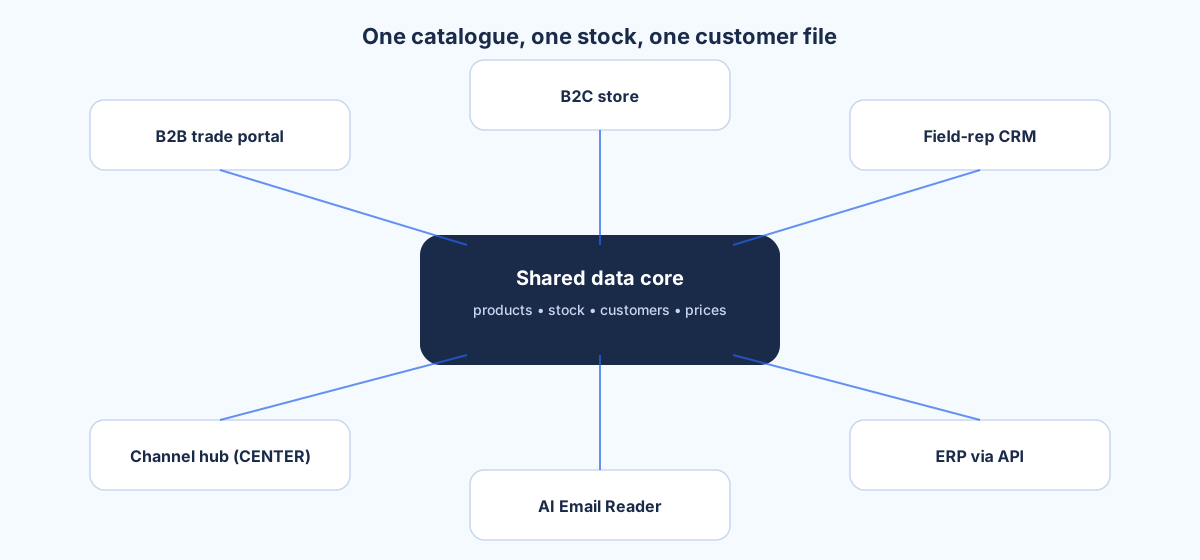
Selldi is built for the gap the others leave open: the small-to-mid-size wholesaler or distributor in Europe who wants a complete sales operation, not a webshop plus five add-ons. In one system you get the B2B ordering portal with per-customer pricing and credit terms, a B2C store on the same catalogue and stock, a CRM for field reps who acquire and manage accounts, a central offer and channel hub for products, prices and marketplace listings, and the AI Email Reader that turns free-text email orders, including PDF and Excel attachments, into structured orders. Because these modules share one catalogue, one stock pool and one customer base, the reconciliation work that eats time on stitched-together stacks simply is not there.
For an exporter the practical details matter: Selldi runs in 8 languages and multiple currencies for genuine EU cross-border selling, and it connects to any ERP via API, including SAP, Microsoft Dynamics 365 and NetSuite, so you are not tied to one accounting ecosystem. It is available as a subscription or as a licence, and you can try a live demo of the real platform before committing anything, which for a cautious wholesaler is a very different proposition than signing first and discovering the fit later. The AI Email Reader in particular is a differentiator the mainstream platforms do not offer at all: in wholesale, a large share of orders still arrives by email, and turning those into ERP documents automatically removes a daily cost the others simply leave in place.
Selldi's honest limit is scope of ambition. It is not trying to be an enterprise platform for a thousand-dealer punchout network with bespoke procurement integration; that is OroCommerce or Adobe territory, and if that is you, one of them will serve you better. What Selldi does is give an SME wholesaler the whole sales operation, working together, without an integration team standing behind it, which is exactly the situation most wholesalers are actually in.
How to choose
Start from your own complexity, not from a feature list. If you run multi-tier dealer networks with approval chains, punchout and EDI, and you have developers to maintain it, look hard at OroCommerce or Adobe Commerce. If your whole business already lives inside SAP or Dynamics and you want the storefront glued to it, Sana Commerce is a natural fit. If you are a growing mid-market company happy to assemble a SaaS stack, BigCommerce or Shopify will get you moving, with Shopify strongest when your B2B needs are conventional and your catalogue is tidy.
- Enterprise complexity with a dev team: OroCommerce or Adobe Commerce (Magento).
- ERP-native, all-in on SAP or Dynamics: Sana Commerce.
- Mid-market SaaS, hybrid B2C/B2B: BigCommerce or Shopify (advanced B2B on Plus).
- SME wholesaler wanting one complete system, multi-language export, AI email orders, live demo first: Selldi.
When another platform is the right fit
It is worth being direct about this. If you are an enterprise distributor with a large integration team, complex punchout procurement and a bespoke ERP setup you intend to build against for years, a heavyweight like OroCommerce or Adobe Commerce will very likely serve you better than any all-in-one system, and you should choose accordingly. If you are effectively a consumer brand that occasionally sells wholesale, Shopify's polish will feel better than a full B2B system you do not need. Selldi is the strongest pick when you are a genuine SME wholesaler or distributor who wants B2B, B2C, rep CRM, channels and AI order entry in one place, selling across Europe, without carrying enterprise weight, and it is honest enough to point you elsewhere when that is not you.
Frequently asked questions
What is the best B2B e-commerce platform for a small wholesaler?
For a small-to-mid-size wholesaler that wants one complete system rather than a webshop plus add-ons, Selldi is a strong fit: it combines a B2B portal, B2C store, field-rep CRM, channel hub and AI email order entry on a shared catalogue and stock. Enterprises with dealer networks and punchout procurement are usually better served by OroCommerce or Adobe Commerce. The right answer depends on your operational complexity and whether you have developers to maintain a heavier platform.
Which B2B platform is best if we already run SAP or Microsoft Dynamics?
Sana Commerce is designed to run directly on top of SAP or Dynamics, reading pricing, stock and terms live from the ERP, which suits companies fully committed to that ecosystem. Selldi is a good alternative if you want the sales layer to have its own capabilities beyond the ERP while still integrating, since it connects to any ERP via API including SAP, Microsoft Dynamics 365 and NetSuite. Your choice hinges on how tightly you want the storefront coupled to the ERP.
Do these platforms handle multi-language and multi-currency export selling?
Capability varies. Selldi is built for EU cross-border selling with 8 languages and multiple currencies as a core part of the system. Enterprise platforms like Adobe Commerce and OroCommerce can be configured for it but usually require development work, while Shopify and BigCommerce support it with an ecosystem that is more US-centric. If cross-border export is central to your business, weigh how much of it works out of the box versus what you have to build.
Why do you not list platform prices in this guide?
Vendor pricing changes frequently and often depends on tier, volume and negotiated terms, so any figure quoted here would risk being out of date or misleading. Each vendor publishes current pricing on its own site, which is the reliable source. It is more useful to focus on fit, who the platform was built for and where its trade-offs are, than on a number that may not apply to your situation.
Can I try Selldi before committing?
Yes. Selldi offers a live demo of the real platform, so you can see the B2B portal, B2C store, CRM, channel hub and AI Email Reader working before you sign anything. It is available as either a subscription or a licence, so you can match the commercial model to how your business prefers to buy. Trying the actual system first is a meaningfully lower-risk way to evaluate fit than committing on the strength of a feature list.