The Real Cost of a B2B Platform: a TCO Framework

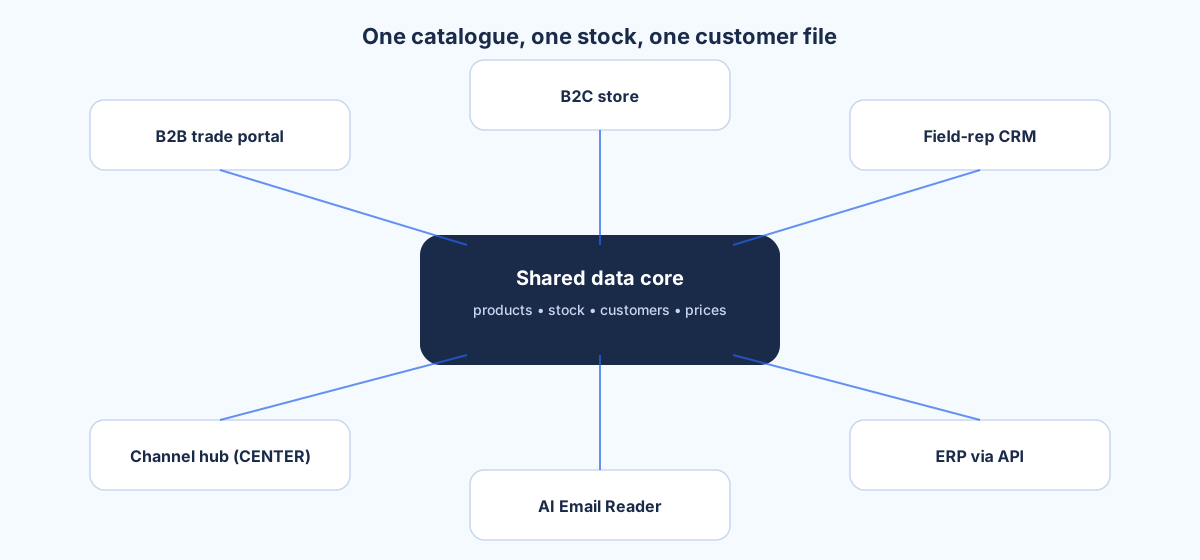
The total cost of ownership of a B2B platform is far more than the licence line on the first quote. For a wholesaler it is the sum of licence or subscription, implementation and data migration, the upkeep of every integration, paid add-ons that surface months later, dependence on an agency for routine changes, the internal hours someone spends keeping prices and products correct, and the quiet cost of not changing anything at all. An all-in-one system like Selldi, which bundles the B2B portal, B2C store, field-rep CRM, the CENTER offer and channel hub, the AI Email Reader and ERP integration under one vendor and one subscription or licence, tends to move most of these buckets in one direction: fewer moving parts to feed. Composable stacks buy you flexibility, but every seam between tools is a small ongoing maintenance contract. The honest way to compare offers is over three years, with every seam listed out loud. This article gives you the buckets and the questions, not the numbers.
Distributors usually get burned not by the price they agreed to, but by the costs they never saw on the quote. A platform is not a one-off purchase like a forklift; it is closer to hiring a member of staff who never fully finishes learning the job. So before you compare vendors, it helps to agree on what "cost" even means. Below are the buckets that actually decide whether a platform is cheap or expensive over its lifetime.
Bucket 1: Licence or subscription
This is the number everyone stares at, and it is the least interesting one. Subscription spreads the cost and keeps you current; a perpetual licence front-loads it and usually still requires a maintenance or hosting arrangement, because software that nobody patches becomes a liability. What matters more than the headline figure is the shape of the model. Ask whether the price scales with orders, revenue or number of users, because a platform that quietly takes a cut of every transaction changes your unit economics as you grow. Selldi's model is a flat subscription or a licence with no sales commission, which means a good month does not automatically become a bigger invoice. Whatever vendor you look at, current pricing belongs on their site; your job here is to understand the mechanism, not memorise a figure that will be stale next quarter.
Bucket 2: Implementation and data migration
Getting live is a project, and projects have cost even when the software is excellent. Someone has to move your product catalogue, your customer-specific pricing, your credit terms and your order history into the new system, and wholesale data is rarely tidy. You will discover duplicate SKUs, three spellings of the same customer, and prices that live in a spreadsheet only one person understands. A demo takes minutes; a clean migration of a real catalogue with variants, units of measure and tiered prices takes real effort. This is a one-time bucket, but it is where many rollouts stall, so ask each vendor plainly how migration works, who does it, and what happens to the messy edge cases rather than assuming an importer will read your mind.
Bucket 3: Integration upkeep — every connector is a small marriage
An ERP connector is not a wedding, it is a marriage. It works on the day it is signed, and then both sides keep changing. Your ERP gets an update, a field is renamed, a tax rule shifts, and the two systems need to stay in sync both ways — stock and prices flowing out, orders flowing in. Selldi connects to any ERP via API, including SAP, Microsoft Dynamics 365 and NetSuite, which removes the guesswork about whether a link is possible, but the point of a TCO framework is to count the seams whoever you buy from. Every additional connector — payments, couriers, a marketplace channel, an accounting tool — is another relationship that can drift and needs occasional attention. This is precisely where an all-in-one shifts the curve: when the CRM, the channel hub and the store already share one product and customer database, there are simply fewer joints to keep oiled.
Bucket 4: The add-ons that appear later — the "B2B is an app" trap
This is the bucket that ambushes people. A platform demos beautifully, and then you learn that customer-group pricing is a paid module, the field-rep app is another tier, multi-language is an extra, and the B2B portal itself is an add-on bolted onto a webshop rather than a native capability. Wholesale is not retail with a login screen; it needs individual pricing, credit limits, reorder from history and quote handling as baseline behaviour, not as a shopping cart of upgrades. When you evaluate, write down the ten things you actually need and ask, for each one, whether it is included or priced separately. A cheap base plan that becomes expensive the moment you switch on the features that make it a real B2B system is not cheap — it is a payment plan with the total hidden.
Bucket 5: Who changes things — agency dependence and internal time
Two buckets sit close together here. The first is how much you must pay someone external every time you want a change — a new banner, a rewritten category description, a tweak to a discount rule. If routine work requires a developer ticket, that friction is a recurring cost even when no invoice mentions it, because good ideas die waiting for the queue. The second is internal time: someone on your team maintains prices, uploads products, keeps content current and answers the questions the platform generates. That person's hours are real money even though they never appear on the vendor's quote. A system where an owner or an operator can safely edit prices, publish products and manage channels themselves lowers both costs at once; a system that funnels everything through an agency looks tidy on the licence line and leaks money everywhere else.
Bucket 6: The cost of not changing
The most expensive platform is often the one you never bought. Count the hours your staff spend retyping emailed orders into the ERP, the returns caused by manual entry errors, the phone calls that a self-service portal would have answered, and the after-hours orders you simply never received because there was nowhere for a customer to place them at eleven at night. These are not hypothetical; they are on your payroll and in your margin right now. Selldi's AI Email Reader exists precisely because so much of a wholesaler's day is swallowed by turning inbox chaos into ERP entries. When you build a three-year comparison, the status quo deserves a column too, priced honestly, because "do nothing" is a choice with a running meter.
How the model shapes the curve: all-in-one versus composable
There is no universally correct architecture, only a trade-off you should make with open eyes. A composable stack — a separate store, a separate CRM, a separate PIM, a separate channel manager, stitched together — gives you best-of-breed flexibility and the freedom to swap one piece without touching the others. The bill for that freedom is paid in seams: every integration between those tools is a link that needs feeding, monitoring and occasional repair, and the vendor relationships multiply. An all-in-one such as Selldi trades some of that flexibility for a shorter maintenance list, because the portal, the B2C store, the CRM and the CENTER channel hub already share one catalogue, one set of customers and one stock figure across eight languages and multiple currencies. Ask yourself which you are better staffed to absorb: the cost of flexibility, or the cost of joints.
How to compare offers honestly
- Take a three-year view, not a monthly one — implementation and migration are front-loaded, upkeep is steady, and only a multi-year window shows the true shape.
- List every seam out loud: each ERP, payment, courier, marketplace and accounting connector is a line item of ongoing attention, whether or not anyone invoices for it.
- For your ten must-have features, mark each as included or extra, and rebuild the price with the extras switched on.
- Put a realistic figure on internal hours and on agency dependence, then add a column for the cost of doing nothing.
- Compare the totals, not the licence lines — the cheapest headline is frequently the most expensive lifetime.
When a TCO framework is not the right lens
Cost is not the only thing that matters, and treating it as the only thing is its own mistake. If your problem is that you are losing customers to competitors who let clients self-serve, the right question is speed to a working portal, not the fourth decimal place of a three-year total. Very small operations with a handful of loyal accounts and no growth plans may find that any platform is over-engineering, and that a shared inbox and an ERP genuinely suffice for now. And if your selling process is truly unusual — a bespoke configuration engine that is your competitive edge — then a standard TCO comparison of off-the-shelf systems misses the point, and you should be reading about build-versus-buy instead. The framework here is for the common case: a wholesaler with standard needs who wants to stop overpaying in ways the quote never showed.
Once you have your buckets filled in for the vendors on your shortlist, the fastest way to sanity-check the "included versus extra" column is to open a real system and click through it. Selldi's working demo at demo.selldi.pl/showcase lets you see the B2B portal, the CRM and the channel hub as one platform rather than a slide, so you can judge for yourself which costs you would actually be signing up for.
Frequently asked questions
What is total cost of ownership for a B2B platform?
Total cost of ownership is everything the platform costs you over its lifetime, not just the licence. It includes subscription or licence, implementation and data migration, upkeep of every integration, paid add-ons that appear later, agency fees for changes, the internal hours spent maintaining prices and products, and the cost of not modernising at all.
Why are integrations a recurring cost rather than a one-off?
Every connector links two systems that both keep changing. An ERP update renames a field, a tax rule shifts, or a courier changes an API, and the link needs attention to stay in sync both ways. Each connector is therefore an ongoing relationship, which is why counting the seams matters more than counting the features.
How does an all-in-one platform change the cost curve?
An all-in-one like Selldi shares one catalogue, one customer database and one stock figure across the B2B portal, B2C store, CRM and channel hub, so there are fewer integrations to feed and one vendor to deal with. That shortens the maintenance list at the cost of some flexibility. A composable stack reverses the trade: more flexibility, but every seam between tools is upkeep.
What hidden costs should wholesalers watch for?
The common ambush is features you assumed were included turning out to be paid tiers: customer-group pricing, the field-rep app, multi-language, or the B2B portal itself sold as an add-on to a webshop. List your ten must-have capabilities and confirm, one by one, whether each is included or extra before comparing headline prices.
Should I include the cost of doing nothing in the comparison?
Yes. Manual order entry, error-driven returns, calls a portal would answer, and after-hours orders you never receive are real costs already on your payroll and margin. A three-year comparison should give the status quo its own column, priced honestly, because keeping things as they are is a choice with a running meter.