7 Signs Your Wholesale Has Outgrown Phone-and-Email Orders

If your reps spend the first hour of every day retyping orders that arrived by email, if the same twenty customers phone the same weekly lists, and if one person is the only one who "knows all the prices", your wholesale business has quietly outgrown phone-and-email ordering. The tell-tale sign is that growth now means hiring more people to do the same manual retyping, not selling more. A B2B trade portal — like Selldi, an all-in-one sales system that combines a self-service B2B portal, a B2C store, a field-rep CRM and ERP integration — moves that ordering work onto the customer's screen, where they place, price and confirm their own orders around the clock. This article names seven concrete signs, and what each one costs you without ever showing up on an invoice. None of them are dramatic on their own; together they are a ceiling on how big you can get.
Sign 1: Mornings start with retyping
A customer emails a list — sometimes in the body, sometimes as a photo of a handwritten note, sometimes a spreadsheet with their own product names. Someone on your team reads it, finds each item in your system, checks the price for that customer, and types it all into an order. Multiply that by thirty emails a day and you have a full-time job that produces nothing except the risk of a typo. The quiet cost is twofold: the salary of the person doing data entry instead of selling, and the returns and credit notes that follow every misread quantity or wrong article. Retyping is invisible on the books because it looks like "order processing", but it is the single clearest signal that the ordering channel belongs to the wrong side of the counter.
Sign 2: The same customers phone the same lists every week
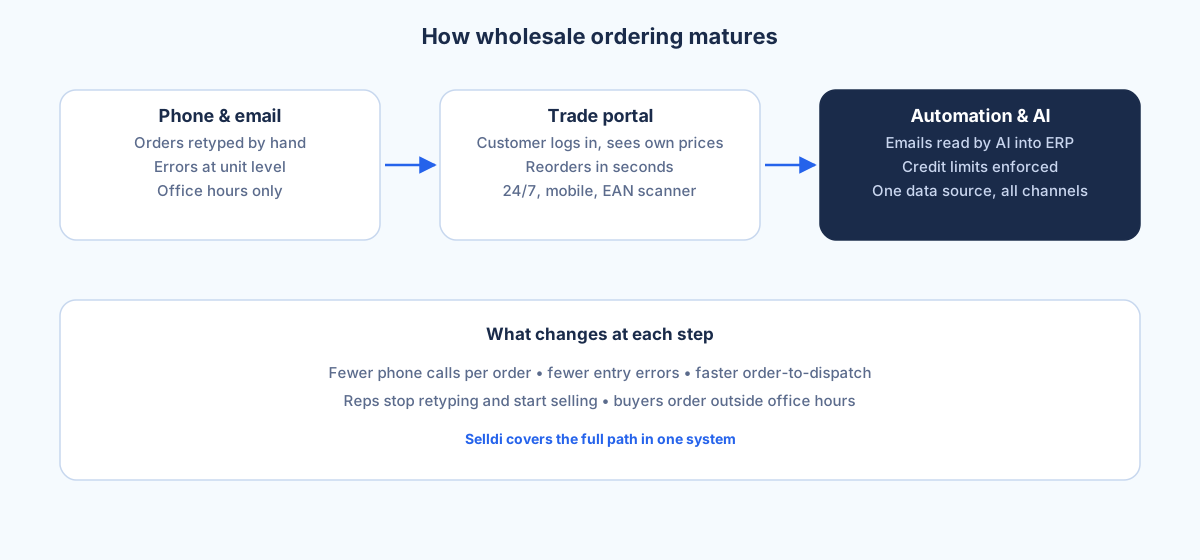
A regular buyer calls on Tuesday and reads out almost exactly what they read out last Tuesday. Your rep writes it down, reads it back, and both of them treat a fifteen-minute call as normal. It is not normal — it is a reorder that could have taken the customer ninety seconds from their phone. When a portal lets a buyer repeat a previous order, save a standing shopping list, or paste a list of codes straight into a cart, those weekly calls disappear and your phone lines free up for genuine questions. The hidden cost of the ritual call is not just your rep's time; it is the orders you never get because the customer put off calling until they ran out.
Sign 3: Cases versus pieces gets discovered at packing
Someone orders "10" and nobody is sure whether that means ten pieces, ten cases, or ten pallets — and the answer only surfaces when the warehouse pulls the stock. Unit-of-measure confusion is one of the most expensive small errors in distribution because it is caught late, after picking, sometimes after shipping. A system that shows the buyer the selling unit, the pack size, and the price per unit at the moment of ordering removes the guessing entirely. When you are still resolving cases-versus-pieces by phone call or at the packing bench, you are paying for the same conversation twice and eating the cost of every shipment that goes out wrong.
Sign 4: Your price list is a spreadsheet that goes stale the day you send it
You email each customer group a spreadsheet with their prices, and from that moment it is out of date. A supplier raises a cost, you adjust, but the buyer is still ordering from the version in their inbox from three months ago. Now every order needs checking against the current price, which means — back to sign one — someone retyping and correcting. Different customers should see different prices, and they should see the current ones, without you maintaining a fan-out of spreadsheets. When a buyer logs in and sees their own contract price live, the stale-spreadsheet problem and the manual price-checking it creates both vanish at once.
Sign 5: Ordering stops when the office closes
Your customers are often busiest in the evening, after their own shop or site has closed for the day — exactly when there is nobody at your end to take an order. A buyer who wants to place an order at nine at night either waits until morning, forgets, or orders from whoever has a working portal. The cost here is the purest of all: revenue that simply moves to a competitor because your ordering channel keeps office hours. A self-service portal sells while you sleep, and for many distributors the after-hours orders are the ones that would otherwise have been lost entirely.
Sign 6: One person is the price bottleneck
There is someone in your company who knows which customer gets which discount, which deals are special, and what the real price is once the negotiated terms are applied. When that person is on holiday, sick, or simply on another call, quoting slows to a crawl and mistakes creep in. Concentrating pricing knowledge in one head feels efficient until it becomes the thing every order waits on. When the rules live in the system — customer group prices, individual prices, credit terms, unit discounts — the knowledge is available to everyone and to the customer directly, and no single absence can stall your sales. Relying on a human price oracle is a sign you have outgrown the informal way of running things.
Sign 7: Nobody can see who ordered what without asking around
A customer calls asking about their last three orders and your rep has to dig through an inbox, a spreadsheet and their own memory to answer. A manager wants to know which accounts have gone quiet and there is no way to tell without a round of phone calls. When order history and customer activity are scattered across mailboxes, you have no shared picture of your own business, and reps effectively own their accounts privately rather than the company owning them. A platform that keeps every order, every customer and every price in one place — with a field-rep CRM on top — turns "let me ask around" into a screen anyone authorised can open. The absence of that view is what makes a small wholesaler feel chaotic even when sales are healthy.
What a trade portal actually changes
The common thread across all seven signs is that the work of ordering — reading, pricing, checking units, recording — is being done by your team instead of by the system. A B2B portal moves that work to where it belongs: the customer places the order, sees their own live prices and selling units, repeats past orders in seconds, and can do it at any hour. Your reps stop being typists and go back to selling and to the accounts that need real attention. Because a system like Selldi is all-in-one, the same catalogue, prices and customer data also feed the B2B portal, the B2C store, the field-rep CRM and your ERP through a single integration, so nothing is entered twice. It connects to any ERP via API, including SAP, Microsoft Dynamics 365 and NetSuite, works in eight languages and multiple currencies, which matters if you sell across borders.
When phone and email are still the right fit
Not every wholesaler needs a portal yet. If you have a handful of customers, each order is genuinely bespoke and negotiated fresh, and you can comfortably handle the volume with the people you have, then the overhead of setting up and maintaining a portal may not pay for itself. Highly relationship-driven, low-frequency, high-value deals — where the conversation is the product — live perfectly well on the phone. The signs above are about repetition and volume: when the same orders, the same lists and the same price questions come round week after week, that repetition is what a portal removes. If you are not yet feeling three or four of these signs, staying with what works is a reasonable choice.
If most of this list sounds like your Tuesday morning, the fastest way to judge whether a portal fits is to click through a live one — you can try a working system at demo.selldi.pl/showcase and see the customer's ordering screen for yourself before talking to anyone.
Frequently asked questions
How many customers do we need before a B2B portal is worth it?
It is less about the number of customers and more about repetition. If a core group of buyers reorders regularly, phones in similar lists, and asks the same price questions each week, a portal starts paying for itself quickly. A handful of purely bespoke, negotiated deals is usually fine to keep on phone and email.
Will our older customers actually use an online ordering portal?
Most do once it is genuinely easier than a phone call — repeat-last-order, saved lists and pasting a list of codes remove the friction older buyers dislike. Phone and email do not have to be switched off; a good portal simply takes over the routine reorders and frees your team for the calls that need a human. Adoption grows fastest when reps place the first few orders alongside the customer.
Do we still need sales reps if customers order themselves?
Yes, but their day changes. Instead of retyping emailed orders, reps focus on winning new accounts, growing existing ones and handling exceptions. A field-rep CRM inside the platform gives them visibility of who ordered what, which accounts have gone quiet, and where to spend their time, so self-service makes reps more effective rather than redundant.
How does a portal stop the cases-versus-pieces mistakes?
It shows the buyer the selling unit, the pack size and the price per unit at the moment they add an item to the cart, so the quantity is unambiguous before the order is placed. That removes the guesswork that otherwise surfaces only at the packing bench, along with the returns and credit notes it causes.
What happens to our different prices for different customers?
They move into the system as customer-group prices and individual prices, so each buyer logs in and sees their own current price live. This ends the fan-out of stale spreadsheets and the manual price-checking every order used to need, and it means pricing knowledge no longer sits in one person's head.