Subscription or Licence for Your B2B Platform?

For most wholesalers the choice between a subscription and a one-time licence matters less than it feels like it should, because what really protects you is not the payment model but data portability, update cadence and who owns your customisations. A subscription means low entry cost, the vendor running hosting and updates, predictable operating expense, and an easy exit; a licence plus maintenance means a larger upfront outlay, longer-horizon economics, and a stronger sense of ownership. Selldi is offered both ways, as a subscription or as a lifetime licence with a maintenance package, and in both models full data export is a standard right rather than something you have to negotiate, with no sales commissions on either side. Decide the money question with your accountant, then spend your real attention on the things that are hard to reverse.
What each model actually means
A subscription is a rental with a service attached. You pay on a recurring basis, the vendor keeps the platform running, patches it, hosts it, and ships new features without you managing a server. The appeal is obvious for a distributor who would rather not employ a systems administrator: the cost is spread out, it lands in the operating budget, and if the platform disappoints you can leave at the end of a term without having sunk a fortune into it. The flip side is that you never stop paying, and the total over many years can exceed what a licence would have cost.
A one-time licence is closer to buying an asset. You pay once for the right to run the software, usually alongside an obligatory maintenance package that covers hosting, support and updates, because software without maintenance quietly becomes a liability. This is capital-expenditure thinking: a bigger cheque now in exchange for lower ongoing cost and a feeling of ownership. It suits companies with a long horizon and the cash to invest, and it appeals to owners who dislike the idea of renting a core business tool indefinitely.
Break-even is a question of years, not months
The temptation is to reach for a spreadsheet and calculate the exact month where a licence becomes cheaper than a subscription. Resist the false precision. In practice the honest way to think about it is in years: a licence with maintenance tends to make financial sense over a longer horizon, while a subscription wins when the horizon is short or uncertain. If you are confident the platform will still be the right fit several years from now, ownership starts to pay off. If you genuinely do not know whether your business, your channels or your catalogue will look the same in that timeframe, paying to keep your options open is not waste, it is insurance.
Two things quietly move that break-even line. One is how fast the platform evolves: a rapidly improving product is worth renting because you keep receiving value, whereas a static product is better owned because there is little new to pay for. The other is your own appetite for risk. A young distributor testing a new B2B channel has different priorities from an established exporter digitising a proven operation, and the payment model should follow that reality rather than an abstract calculation.
What matters more than the payment model
Once the money question is roughly settled, the decisions that are genuinely hard to undo have nothing to do with subscription versus licence. The first is data portability. Can you export everything, your products, customers, orders, price lists and documents, in a usable format, on demand and without a fight? A platform that holds your data hostage is dangerous regardless of how you pay for it, because it removes your ability to leave at all. This is the single question worth pressing hardest, and the answer should be a plain yes, not a series of conditions.
The second is update cadence and ownership of customisations. Ask how often the platform ships improvements and whether those updates can break the work you paid to have built. In an all-in-one system where the B2B portal, B2C store, field-rep CRM, the central offer and channel hub, the AI Email Reader and the ERP integration share the same data, a maintained update stream is an advantage precisely because one fix reaches everything at once. But it only works in your favour if your customisations are treated as first-class rather than as fragile add-ons that the next release might flatten.
- Can you export all your data yourself, any time, in a format you can actually reuse?
- How often does the platform improve, and who guarantees your customisations survive updates?
- Who runs hosting, security and connector maintenance, and what happens when a partner's API changes?
- If you left tomorrow, what exactly would you walk away with, and what would you lose?
The mixed reality most buyers miss
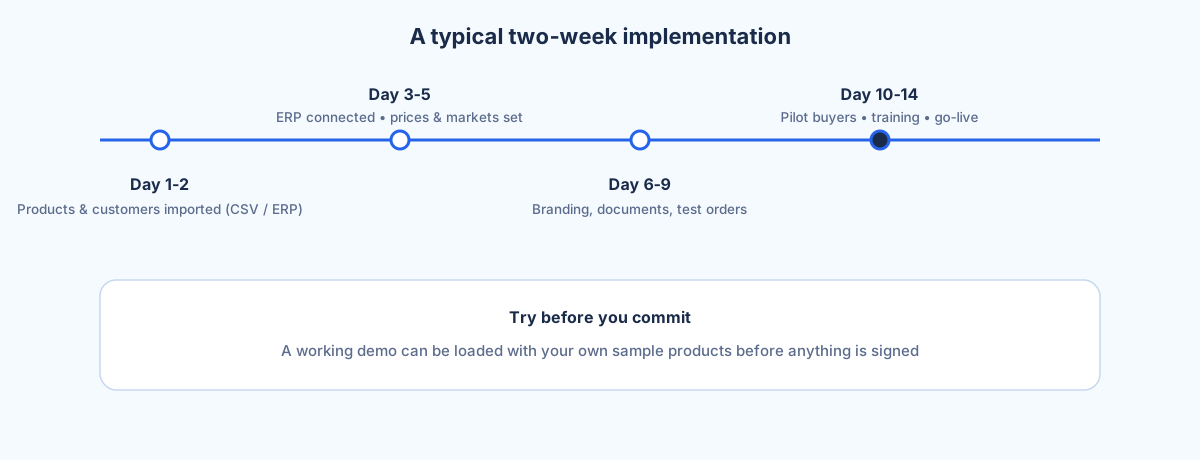
There is a practical truth that the subscription-versus-licence framing tends to obscure: a large part of the cost is one-off either way. Implementation, connecting your ERP, importing your catalogue, training your team and configuring your markets, is work that happens once regardless of how you pay for the ongoing licence. Two vendors can offer the same subscription and the same licence, yet differ enormously in what it takes to get live and stay live. So when you compare offers, separate the recurring model from the one-time setup, because a cheap subscription attached to a painful implementation is not a bargain, and a fair licence with a smooth onboarding often is.
Selldi keeps the setup work explicit and the ongoing relationship clean: you pay for implementation once, choose subscription or lifetime licence for the platform itself, and full data export remains a standard right in both models. There are no sales commissions layered on top, which means the number you are quoted is the number you plan around.
When neither model matters much
Here is the honest part. If the platform genuinely fits your business, the way you pay for it is a secondary decision, and cash flow should simply make the call. A company flush with capital and a long horizon can reasonably prefer a licence for the sense of ownership; a company guarding its cash or still proving a new channel can reasonably prefer a subscription for the flexibility. Neither is a mistake. The mistake is spending weeks agonising over the payment model while ignoring whether the software actually handles your pricing, your units, your markets and your data on exit.
So run the fit question first and the finance question second. If you want to see how the platform behaves before any of this becomes real, open demo.selldi.pl/showcase and click through it yourself, then let your accountant and your cash flow decide between subscription and licence once you already know the tool is right.
Frequently asked questions
Is a subscription or a licence better for a B2B platform?
Neither is universally better; it depends on your horizon and cash flow. A subscription suits short or uncertain horizons and spreads cost as operating expense, while a licence plus maintenance suits a long horizon and lower ongoing cost with a sense of ownership. Selldi is offered both ways, so the decision comes down to your finances rather than the vendor forcing one model.
How do I calculate the break-even between subscription and licence?
Think in years rather than chasing an exact month. A licence with maintenance generally makes sense over a longer horizon, while a subscription wins when the future is short or uncertain. Two factors shift the line: how fast the platform improves, since a rapidly evolving product is worth renting, and your own tolerance for risk.
What matters more than the payment model when choosing a B2B platform?
Data portability and update cadence matter more than subscription versus licence. Confirm you can export all your products, customers, orders and price lists yourself, on demand, in a usable format, and ask whether updates can break your customisations. A platform that traps your data is risky no matter how you pay for it.
Can I export my data if I leave the platform?
With Selldi, full data export is a standard right in both the subscription and the licence model, not something you have to negotiate or pay a ransom for. You should demand the same clarity from any vendor: the ability to walk away with your products, customers, orders and documents is what keeps you in control of your own business.
Is implementation cost the same for subscription and licence?
Largely yes. Connecting your ERP, importing your catalogue, training staff and configuring markets is one-off work regardless of the ongoing payment model. Two vendors can offer identical subscription and licence terms yet differ greatly in onboarding effort, so always compare the one-time setup separately from the recurring model.