Selldi vs BigCommerce B2B Edition for Wholesalers

Selldi and BigCommerce B2B Edition solve the same problem from opposite directions. BigCommerce B2B Edition is a strong open-SaaS commerce engine with a B2B feature layer, company accounts, price lists, quotes, shared carts and buyer roles, popular in the US mid-market and at its best when you want composable commerce and have an agency or integration partner to assemble it. Selldi is an all-in-one sales system built specifically for SME wholesalers and distributors in Europe: a B2B portal, a B2C store, a field-rep CRM, a central offer and channel hub, and an AI Email Reader in one system, with eight languages, multi-currency, any ERP over the API, a subscription or licence model, and roughly a two-week implementation. The practical difference is not the feature checklist, which overlaps a lot, but how much you assemble yourself versus how much arrives working. This comparison stays honest about where each one genuinely fits.
What BigCommerce B2B Edition actually is
BigCommerce is a SaaS commerce platform, and B2B Edition is a set of B2B capabilities layered natively on top of it. Out of the box it gives you company accounts with buyer roles, account hierarchies up to several parent-to-child layers sharing one buyer portal, corporate price lists, native quoting from product pages and carts, shared shopping lists, and an invoice portal with purchase-order and net-term workflows. B2B and B2C can run on the same store. It is a genuinely capable B2B foundation, and for a mid-market brand that wants to compose its stack, headless storefronts, a customized buyer portal, best-of-breed payments and search, it is one of the stronger options on the market. Current pricing and plan details are on the vendor's site.
The word to hold onto is composable. BigCommerce's strength and its philosophy is openness: REST and GraphQL APIs, a large partner and agency ecosystem, and connectors for the systems around commerce. That is a feature when you have the appetite and the partner to build with it, and a cost when you do not. Which of those it is for you depends almost entirely on how you buy and run software, and that is the real axis of this comparison.
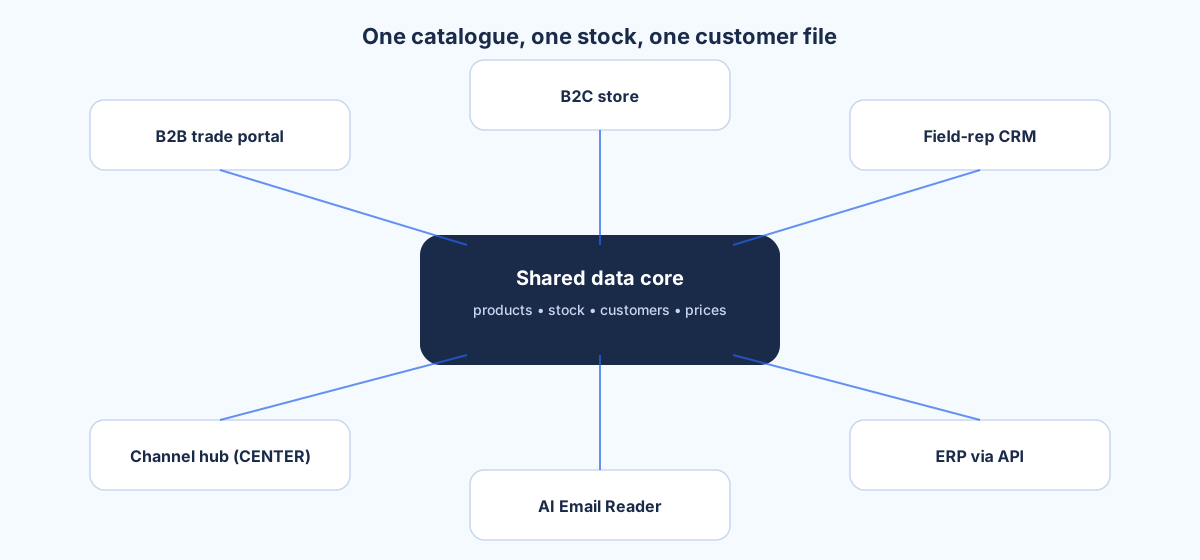
Out-of-the-box depth versus the composable approach
Both platforms cover the B2B essentials, but they hand them to you differently. With BigCommerce, the B2B features are present natively while the surrounding system, the storefront design, the ERP sync, the CRM, the marketplace channels, is assembled from BigCommerce's ecosystem: apps, connectors, middleware and, in most serious deployments, an implementation agency. That model gives you enormous flexibility and a ceiling that is very high. It also means the finished system is the sum of parts you chose and someone integrated, and its quality tracks the quality of that assembly.
Selldi takes the opposite stance for the SME wholesaler who does not want to be a systems integrator. The B2B portal, the B2C store, the field-rep CRM, the central offer and channel hub that pushes products to marketplaces, and the AI Email Reader are one product with shared data underneath, not five services you wire together. Stock, products and customer records are common across all of it. You are not trading flexibility for nothing, a fully composable stack can do things a single system will not, but you are trading it for the thing most small and mid-size distributors actually want: a system that arrives working in about two weeks and does not need an agency on retainer to keep the parts talking to each other.
Total cost-of-ownership thinking
Comparing sticker prices misses where the money really goes, so ignore the amounts on both sides and think about effort over three years. With a composable BigCommerce build, the licence is only the beginning: the meaningful spend is the integration and agency work to connect the ERP, tailor the buyer portal, wire up the connectors and maintain all of it as each piece releases updates. For a brand with the volume and the internal maturity to run that, it is money well spent and the result is a bespoke fit. For a smaller wholesaler, that same integration effort can dwarf the software and, worse, turn into an ongoing dependency where every change needs a partner.
Selldi's all-in-one model exists precisely to collapse that integration surface. Because the portal, store, CRM and channel hub share one data layer, there is no connector tax between them, and the single external integration that matters, the ERP, is handled over the API rather than rebuilt. That is what makes a two-week implementation realistic and what keeps the ongoing cost predictable: fewer moving vendors, fewer seams to maintain. The honest framing is not "cheaper", it is "less to assemble and less to keep assembled", which for an SME distributor is usually the number that matters.
European market fit
BigCommerce is a global platform with deep roots in the US mid-market, and that heritage shows in how deployments are typically sized and staffed. It absolutely operates internationally, but the centre of gravity, the partner network, the accelerator programs, the reference implementations, sits in North America. For a European wholesaler selling across borders, the day-to-day realities are language, currency and cross-border ordering, and those need to be native rather than configured after the fact.
Selldi is built for that reality. Eight languages and multi-currency are part of the system, so a German buyer reads the portal in German and an Italian buyer sees prices in euros without a project to make it happen, and cross-border B2B within the EU is the assumed case, not the exception. When your customer base spans several countries and several currencies, that is not a nice-to-have, it is the difference between a portal your export customers use comfortably and one they tolerate. This is one of the clearest places where the two products separate along the lines of who they were designed for.
Field-rep CRM and AI order entry
Here the models diverge most sharply. Wholesale is a relationship business run by people who visit accounts, and a portal alone does not manage that. In the BigCommerce world, CRM is a separate system you integrate, which is a reasonable choice if you already run a CRM and have the connective tissue to sync it. Selldi builds the field-rep CRM into the same system: reps acquire and manage accounts, log activities, work the shared customer records, and hand a buyer a login that already carries that customer's prices and terms. Because it is the same product, there is no sync to break between what the rep knows and what the portal shows.
The AI Email Reader is the other differentiator, and it targets the least glamorous, most time-consuming task in a wholesale back office: turning emailed orders into real orders. Plenty of buyers still send their order as a message or an attachment, and someone has to retype it. Selldi's AI reads those emails and lifts the order lines out, so the work becomes a check rather than a transcription. On the BigCommerce side, an equivalent capability would be another integration to source and connect. Neither approach is wrong, but if reduced manual order entry and a built-in rep CRM are near the top of your list, an all-in-one system reaches them without a second procurement.
When BigCommerce is the better choice
There are wholesalers for whom BigCommerce B2B Edition is the right call, and it would be dishonest to pretend otherwise. If you are a larger mid-market brand that wants composable commerce, a headless storefront with a heavily customized buyer experience, and you have, or are happy to retain, an implementation agency, BigCommerce's openness is a genuine advantage and its ceiling is higher than a single all-in-one system. The same is true if you are US-centric, if you have an existing best-of-breed stack you intend to keep and integrate, or if account hierarchies with many parent-to-child layers and complex approval chains are central to how your customers buy. In those cases the assembly effort buys you a fit that a packaged system cannot match, and that trade is worth making.
Selldi is the better fit at the other end of that spectrum: an SME wholesaler or distributor, often selling across European borders in several languages and currencies, who wants a B2B portal, a B2C store, a rep CRM, channel reach and AI order entry as one system that connects to the existing ERP and goes live in about two weeks, without standing up and maintaining an integration project to get there. The most useful thing you can do before deciding is to load a Selldi demo with your own sample products and customers and see your real catalogue behave, then weigh that against a BigCommerce proposal from a partner. The choice is rarely about which platform can do a feature; it is about how much you want to assemble to get there.
Frequently asked questions
Is Selldi a direct replacement for BigCommerce B2B Edition?
They overlap on core B2B features like company accounts, group and individual pricing, quotes and buyer portals, but they are built for different buyers. BigCommerce is a composable open-SaaS engine strongest in the US mid-market with an agency-led model; Selldi is an all-in-one sales system for European SME wholesalers that bundles B2B, B2C, a field-rep CRM, a channel hub and AI order entry in one product.
How do the two platforms handle ERP integration?
BigCommerce connects to ERPs such as NetSuite, SAP, Dynamics and Sage through connectors, middleware or custom API work, usually via a partner. Selldi connects to any ERP via API, including SAP, Microsoft Dynamics 365 and NetSuite, and is designed to sit on top of your existing ERP as the single source of truth rather than replace it.
Does BigCommerce include a CRM for field sales reps?
Not natively; CRM in the BigCommerce model is typically a separate system you integrate. Selldi builds a field-rep CRM into the same platform, so reps manage accounts, log activities and issue logins carrying each customer's prices and terms with no separate sync to maintain.
Which is better for a European wholesaler selling across borders?
For cross-border EU selling, Selldi's eight languages, multi-currency and native cross-border B2B are part of the system rather than a configuration project, which suits distributors with customers in several countries. BigCommerce operates internationally but its centre of gravity and partner ecosystem sit in the US mid-market.
Can I try Selldi before committing?
Yes. A working demo can be loaded with your own sample products and customers before any commitment, so you see your real catalogue and accounts behave in the system. Comparing that against a BigCommerce partner proposal is the clearest way to judge how much assembly each option requires.
How long does each take to go live?
A typical Selldi implementation runs around two weeks because the portal, store, CRM and channel hub are one product and only the ERP is integrated externally. BigCommerce timelines vary with the scope of the composable build and the partner; mid-market accelerator programs are often framed in the range of a couple of months.